The Evolution of Indian Smart Cities
The concept of “smart cities” in India reflects the country’s ambition to integrate technology, sustainability, and citizen-centric governance into urban development. It is the result of decades of urban transformation shaped by economic reforms, infrastructure expansion, and technological adoption. India’s smart city journey is not merely about adopting modern gadgets; it is about rethinking how cities can function more efficiently while improving the quality of life for residents.
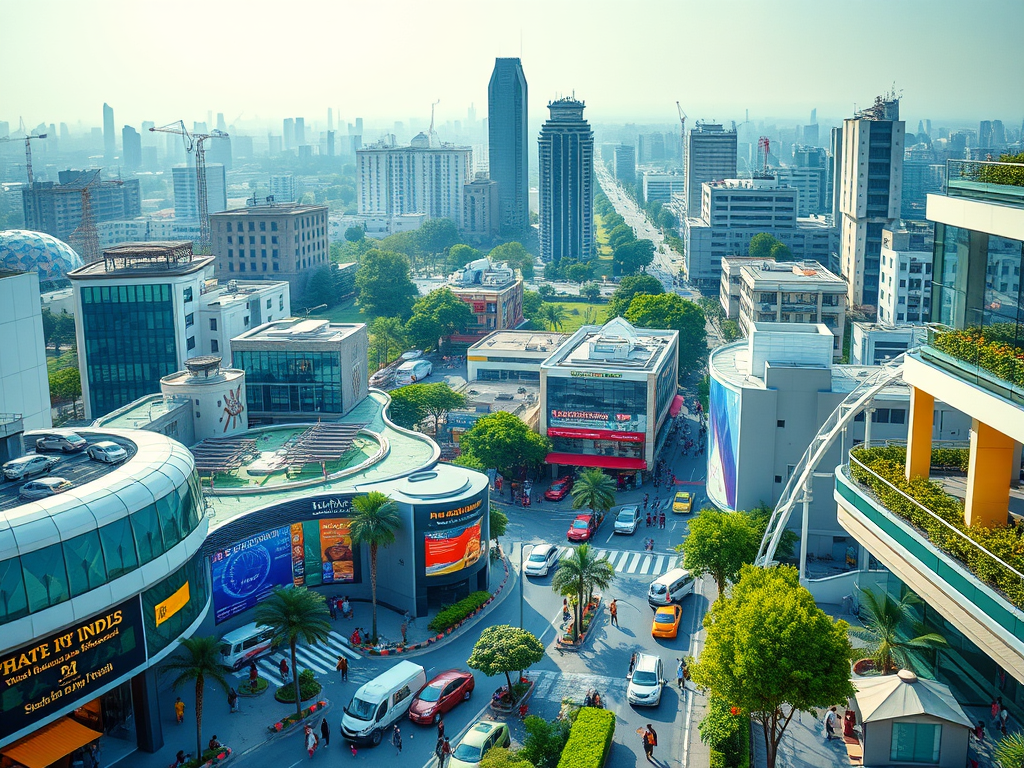
Early Urbanization Trends: Post-independence India experienced steady urbanization, but it was largely unplanned. Industrial hubs like Mumbai, Kolkata, and Chennai grew rapidly, leading to challenges such as traffic congestion, pollution, and inadequate housing. Until the 1990s, urban planning in India primarily focused on basic infrastructure such as roads, public transportation, and sanitation. With the economic liberalization of 1991, urban centers began attracting more investments, which spurred real estate growth and the first experiments with modern city infrastructure.
Digital India and the Birth of the Smart Cities Mission: The real turning point came in the 2010s, as India embraced digital transformation. Initiatives like *Digital India* (2015) and improved broadband connectivity laid the foundation for integrating technology into public services. In 2015, the Government of India launched the Smart Cities Mission (SCM) , aiming to develop 100 cities that leverage information and communication technology (ICT) to improve governance, infrastructure, and service delivery. The mission emphasized three approaches: retrofitting existing areas with smart solutions, redeveloping urban spaces, and creating new “greenfield” developments.
Social and Economic Impact: The evolution of smart cities has extended beyond technology. Projects have focused on creating open public spaces, improving walkability, and promoting cycling culture. They have also boosted employment in IT services, construction, and sustainable energy sectors. However, the transition has faced challenges, including funding gaps, bureaucratic delays, and ensuring equitable access for marginalized communities.
Core Components of Smart Cities
Indian smart cities evolved around key pillars: efficient urban mobility, robust IT connectivity, e-governance, sustainable environment management, and inclusive housing. Smart meters, integrated traffic management systems, Wi-Fi-enabled zones, and app-based citizen grievance platforms became common features. Energy-efficient street lighting, solar power integration, and waste-to-energy plants highlighted the environmental dimension of smart development. Cities like Pune and Surat pioneered command-and-control centers that use real-time data to manage traffic, utilities, and emergency response.
Technological Integration: Over the years, smart cities in India have adopted cutting-edge technologies such as IoT sensors for air and water quality monitoring, GIS-based urban mapping, and AI-driven analytics for traffic flow optimization. These solutions enable predictive maintenance of infrastructure, faster emergency responses, and better allocation of resources. Furthermore, public-private partnerships have been critical in driving investment and innovation, allowing cities to deploy advanced technologies without overburdening municipal budgets. Artificial Intelligence plays a huge role in these application in city management
AI in Smart Cities
Artificial Intelligence (AI) has emerged as a critical driver in the development of smart cities in India, enabling urban areas to become more efficient, sustainable, and citizen-focused. By processing vast amounts of data from sensors, cameras, and digital platforms, AI helps city administrators make better decisions, automate routine tasks, and respond proactively to challenges. In the Indian context, AI adoption in smart cities is aligned with national initiatives like the Smart Cities Mission and Digital India, ensuring that technology directly addresses urban issues such as congestion, pollution, safety, and governance.
1. AI in Urban Mobility and Traffic Management: Traffic congestion has been one of the most persistent problems in Indian cities. AI-driven traffic management systems use data from CCTV cameras, GPS-enabled vehicles, and IoT sensors to monitor traffic flow in real time. Machine learning algorithms can predict congestion hotspots and dynamically adjust traffic signals to optimize movement. Cities like Bengaluru and Delhi have implemented AI-based adaptive traffic signal systems, reducing travel time and fuel consumption. AI is also used in public transport route optimization and predictive maintenance of buses and metro systems.
2. AI-Powered Surveillance and Public Safety: AI-enabled video analytics have revolutionized surveillance in cities such as Surat, Hyderabad, and Lucknow. Cameras equipped with facial recognition, object detection, and anomaly detection algorithms help identify suspicious behavior, track missing persons, and detect rule violations. These systems can automatically alert law enforcement, significantly improving crime prevention and emergency response. Predictive policing, powered by AI, also uses historical crime data to forecast potential criminal activities in specific areas.
3. Environmental Monitoring and Sustainability: AI plays a vital role in environmental management in smart cities. Machine learning models analyze real-time air quality, water quality, and noise pollution data from IoT sensors. For instance, AI systems can predict air pollution levels based on weather patterns and traffic data, enabling authorities to take preventive measures. In waste management, AI-based route optimization for garbage collection vehicles and automated waste segregation using computer vision have improved efficiency and reduced landfill waste.
4. Smart Governance and Citizen Services: AI-powered chatbots and virtual assistants in cities like Pune and Bhopal allow residents to access information about public services, pay bills, lodge complaints, and receive updates through conversational interfaces. Natural Language Processing (NLP) tools help these chatbots understand queries in multiple Indian languages, improving accessibility. AI also helps in automating government workflows, reducing paperwork, and ensuring faster grievance redressal.
5. Infrastructure Maintenance and Urban Planning: AI assists in predictive maintenance of infrastructure such as roads, bridges, and power grids by detecting anomalies in sensor data before a major failure occurs. In urban planning, AI algorithms analyze satellite imagery, demographic data, and land use patterns to recommend optimal locations for new infrastructure projects, green spaces, and housing developments.
6. Healthcare and Emergency Response: AI is being used to improve urban healthcare by predicting disease outbreaks through data from hospitals, pharmacies, and environmental sensors. In emergencies such as floods or fires, AI-enabled disaster management systems use real-time data and simulations to guide evacuation plans and resource allocation.
AI serves as the backbone of many smart city initiatives, enabling urban services to become more efficient, adaptive, and citizen-oriented. The effectiveness of these projects depends heavily on the choice and application of algorithms, each designed to address specific challenges in traffic management, environmental monitoring, public safety, governance, and urban planning. One of the most widely used categories of algorithms in smart cities is machine learning (ML). Within ML, supervised learning algorithms such as decision trees, random forests, and support vector machines (SVMs) are employed for predictive tasks. For example, traffic congestion forecasting or predicting power consumption patterns rely on historical and real-time datasets analyzed through these models. Regression algorithms help in forecasting pollution levels or demand for utilities, enabling proactive responses by city administrators. Unsupervised learning methods, such as K-means clustering and hierarchical clustering, are valuable for pattern detection in large datasets. They are often used for segmenting areas based on crime rates, classifying neighborhoods by energy consumption, or grouping waste collection zones for optimization. These algorithms do not require labeled data, making them ideal for exploratory urban data analysis. In scenarios requiring decision-making over time, reinforcement learning (RL) algorithms are increasingly applied. RL enables systems to learn optimal strategies by interacting with the environment and receiving feedback in the form of rewards or penalties. For instance, adaptive traffic signal control systems use RL to minimize wait times and reduce congestion by continuously adjusting signal timings. Deep learning techniques have also gained prominence, especially in video analytics and image recognition for public safety and surveillance. Convolutional Neural Networks (CNNs) are the primary choice for tasks like facial recognition, license plate reading, and object detection in CCTV footage. These algorithms power AI-enabled security systems in cities like Surat and Hyderabad, helping in crime detection and anomaly identification. In environmental monitoring and predictive maintenance, time-series forecasting algorithms such as ARIMA, LSTM (Long Short-Term Memory networks), and Prophet are used. These algorithms excel in analyzing temporal data trends, such as predicting air quality index changes or identifying when city infrastructure might fail. For natural language-based citizen services, Natural Language Processing (NLP) algorithms, including transformer-based models like BERT and GPT, enable chatbots and voice assistants to interact with citizens in multiple languages. These systems are used for grievance redressal, information dissemination, and service requests. Lastly, optimization algorithms like genetic algorithms and simulated annealing are applied in urban planning, such as determining optimal routes for waste collection or positioning public charging stations for electric vehicles. These examples are not all from an Indian context but could be applied to the Indian context as well, based on their success stories across the globe.
Challenges in Implementing AI for Smart City Services in India
In India’s Smart Cities Mission, AI plays a vital role in areas such as traffic management, public safety, environmental monitoring, governance, and urban planning. However, translating AI’s potential into practical, reliable, and inclusive services has proven challenging for city governments. These challenges are rooted in technological, infrastructural, financial, and socio-political factors that need to be addressed for AI to deliver lasting impact. One of the foremost obstacles is data availability and quality. AI thrives on large, clean, and structured datasets, yet most Indian cities face data silos, where information is stored in separate departmental systems without integration. In many cases, the data that exists is incomplete, outdated, or collected in inconsistent formats. The absence of reliable historical datasets further limits the ability of AI models to make accurate predictions or optimizations. Another major hurdle lies in infrastructure costs. Implementing AI in smart cities requires a vast network of IoT devices, sensors, and high-definition cameras to collect data in real time. Setting up this infrastructure demands significant capital investment, while ongoing maintenance—especially in challenging weather and environmental conditions—adds to operational expenses. Additionally, AI processing requires robust computing infrastructure, whether through on-premise high-performance servers or cloud-based platforms, both of which come with recurring costs. The shortage of skilled manpower in municipal bodies is another limiting factor. AI systems require data scientists, machine learning engineers, and cybersecurity experts to operate and maintain them. Most city governments do not have this expertise in-house, and training existing staff requires time, resources, and institutional commitment. Integration and interoperability issues also hinder smooth AI deployment. Many urban governance systems in India run on outdated software and hardware, making it difficult to connect them with modern AI platforms. Furthermore, cities often depend on proprietary solutions from different technology vendors, leading to incompatibility and vendor lock-in. Concerns over cybersecurity and data privacy add another layer of complexity. AI-enabled systems process sensitive personal and location data, making them attractive targets for cyberattacks. Weak security protocols, inadequate encryption, and evolving data protection laws mean that both citizens and governments face risks related to surveillance, identity theft, and unauthorized access. In addition to technical barriers, there is resistance to change within administrative and political systems. Bureaucratic processes in India are often slow, and decision-making may favor traditional methods over AI-driven recommendations. Public trust issues also arise, particularly when AI is used in areas like facial recognition and predictive policing, where transparency and accountability are crucial. Finally, questions of scalability, sustainability, and ethics persist. Many AI-based smart city projects start as small pilot programs but fail to scale due to funding shortages or political changes. AI systems also raise ethical concerns about bias, discrimination, and lack of transparency in decision-making, especially if they are trained on unrepresentative datasets.
In conclusion, while AI and other emerging technologies hold enormous promise for improving governance and quality of life in India’s smart cities, its implementation faces significant hurdles. Addressing these challenges will require a multi-pronged approach: building robust data infrastructure, investing in skilled manpower, ensuring cybersecurity, promoting system interoperability, and fostering citizen trust through transparency and ethical AI practices. Only then can AI evolve from an experimental tool into a sustainable pillar of urban governance in India. The future of Indian smart cities lies in deeper citizen engagement, resilient infrastructure, and adaptive governance. As climate change intensifies, smart cities will need to integrate disaster resilience, green urban planning, and renewable energy at larger scales. With the growth of 5G, AI, and big data, Indian cities are poised to become more responsive, inclusive, and sustainable. In essence, the evolution of smart cities in India reflects a shift from reactive urban management to proactive, technology-driven planning. While challenges remain, the journey has already transformed how Indian cities envision their role in the 21st century—offering a model for sustainable, citizen-focused urban living.
In view of the above case of Indian Smart Cities, answer these 4 questions while thinking like an IAS officer:
Q1) How can public servants design services for smart cities for autonomous or sequential search (either one) for hybrid problem solving involving AI and Human agents? Explain through an example.
Q2) In this example you provided for autonomous or sequential search (either one) for hybrid problem solving involving AI and Human agents, explain how data network effects can create value for the citizens of smart cities.
Q3) How can public servants design services for smart cities for sequential or interactive search (either one) for hybrid problem solving involving AI and Human agents? Explain through an example.
Q4) In this example you provided for sequential or interactive search (either one) for hybrid problem solving involving AI and Human agents, explain how data network effects can create value for the citizens of smart cities.

 Tech Talk
You must be logged in to post a comment.