Category: Technology

How Generative AI Is Rewriting the Insurance Playbook

How Generative AI Is Rewriting the Insurance Playbook

Insurance has always been a business of words and numbers. Policies, endorsements, exclusions, claim forms, adjuster notes, medical reports, loss histories: the industry runs on mountains of documents that humans have spent decades reading, summarising and re-keying. That is exactly why generative AI, a technology built to read, write and reason over language, is landing in insurance with unusual force.

Continue reading “How Generative AI Is Rewriting the Insurance Playbook” →
Pinterest Keywords for Beginners: 8 Questions Answered

Pinterest Keywords for Beginners: 8 Questions Answered

Search for “small kitchens” on Pinterest, and you will see how the autofill function completes the rest of your sentence for you. This is what Pinterest is all about. It is basically a search engine which uses images to search instead of keywords.

Continue reading “Pinterest Keywords for Beginners: 8 Questions Answered” →
Tarangini Bank: Knowing the Customer using Artificial Intelligence

Tarangini Bank: Knowing the Customer using Artificial Intelligence

Tarangini Bank, a mid-sized private sector bank founded in 1946 in Mangaluru, serves 14 million customers through 1,150 branches. By 2026, UPI, fintech competition, a squeeze on low-cost deposits and new data-protection rules are reshaping Indian retail banking. The bank’s segmentation still rests almost entirely on account balance. As a result, campaign response rates are poor, offers miss the mark, and valuable customers leave without warning. Ananya Deshpande, the bank’s new Chief Digital and Analytics Officer, proposes a segmentation built on demographics and on how customers actually spend across categories and channels, using k-means clustering. Her team must deal with duplicate customer records, stale demographic data, unclear UPI transactions, privacy obligations and a sceptical branch network. A pilot produces six clear segments that cut across the old balance tiers. Deshpande must now recommend to the board how quickly to roll out the new segmentation, which method to use, and how to turn the insight into a more customer-focused bank.

Continue reading “Tarangini Bank: Knowing the Customer using Artificial Intelligence” →
Customer Network Value and How It Is Estimated

Customer Network Value and How It Is Estimated

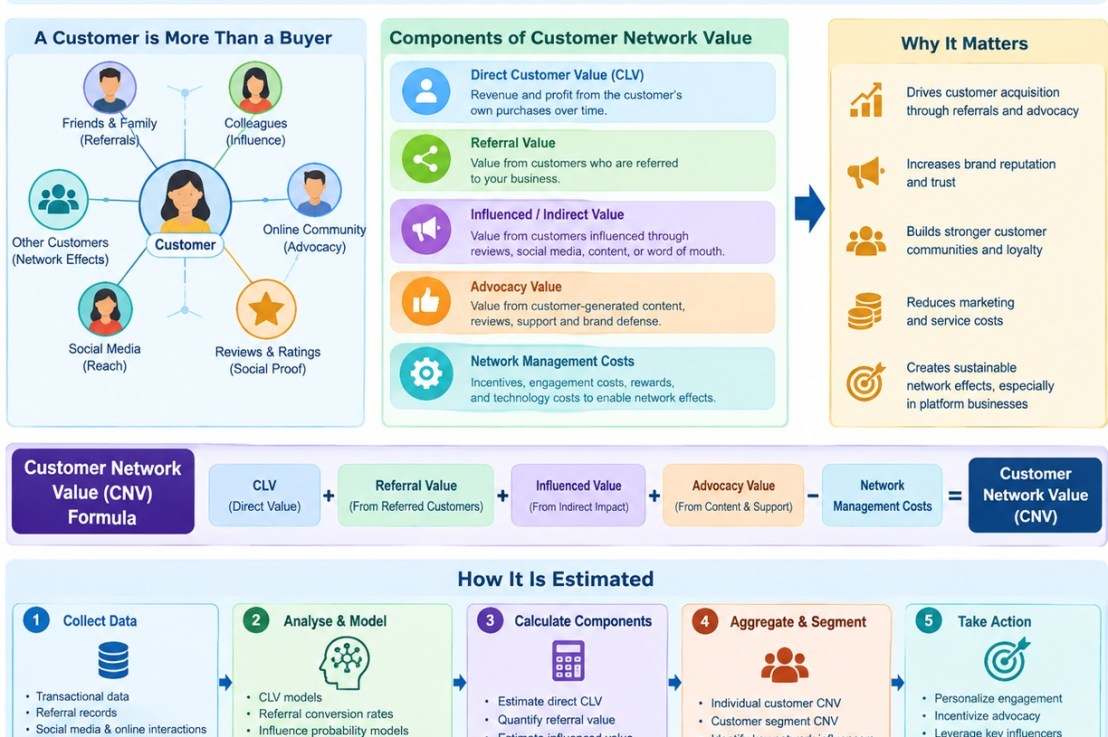
Traditional customer relationship management has generally evaluated customers according to the economic value of their own transactions. Measures such as sales revenue, customer lifetime value (CLV), retention rate, and purchase frequency help organizations identify customers who generate greater direct financial returns. However, in digitally connected markets, a customer can create value that extends far beyond his or her own purchases. Customers influence friends, colleagues, online communities, social-media audiences, and other potential customers. They may provide referrals, generate reviews, create content, strengthen brand reputation, and facilitate access to other customers. The economic value generated through these relationships can be conceptualized as customer network value (CNV).

Continue reading “Customer Network Value and How It Is Estimated” →
Choosing Between Wireless Bridges, Outdoor Access Points and 4G/5G Routers for Remote Business Connectivity

Choosing Between Wireless Bridges, Outdoor Access Points and 4G/5G Routers for Remote Business Connectivity

A wireless bridge links two fixed locations, an outdoor access point serves Wi-Fi devices across an open area, and a 4G/5G router brings internet service to a site through a mobile network. Businesses comparing commercial outdoor wireless access point options should therefore start with the traffic path, not the largest advertised speed. This guide explains where each technology fits and when a combined design is more practical.

Continue reading “Choosing Between Wireless Bridges, Outdoor Access Points and 4G/5G Routers for Remote Business Connectivity” →
How SMEs Can Build a Reliable Wi-Fi Network for Offices, Warehouses and Multi-Site Operations

How SMEs Can Build a Reliable Wi-Fi Network for Offices, Warehouses and Multi-Site Operations

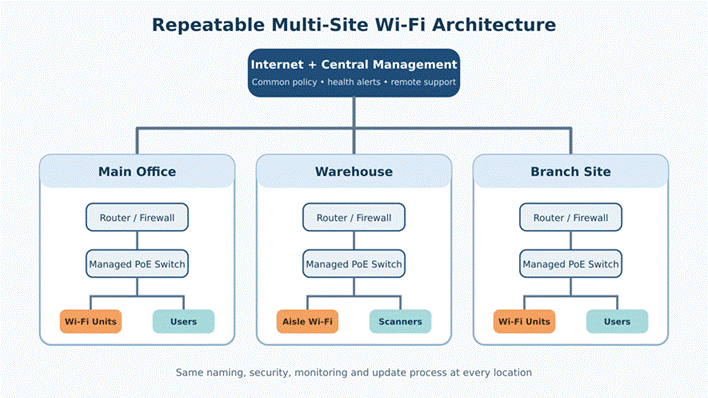
Reliable business Wi-Fi does not come from one powerful router in the middle of a building. It needs a stable wired core, well-placed access point units, separate networks for different users, and simple monitoring. SMEs comparing ceiling-mounted access point options should first map where people work and which devices must stay online.

Continue reading “How SMEs Can Build a Reliable Wi-Fi Network for Offices, Warehouses and Multi-Site Operations” →
Reliable Network Infrastructure for Scalable IoT and Edge Deployments

Reliable Network Infrastructure for Scalable IoT and Edge Deployments

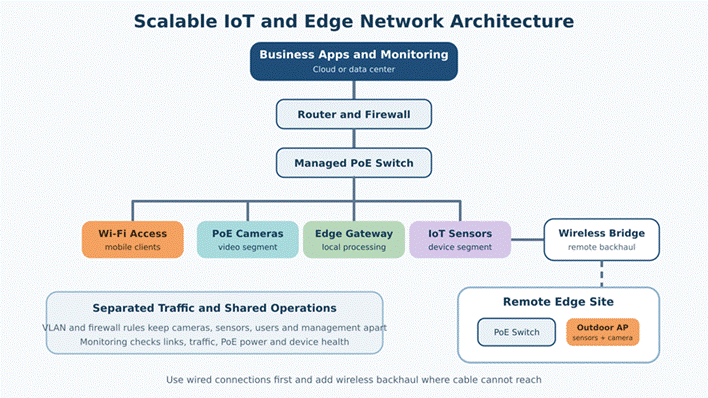
A scalable IoT network starts with the work each device must do. Sensors may send small readings, while cameras and edge computers can move large amounts of data. The network also needs stable power, safe access, and a clear path to business systems. Teams comparing outdoor wireless access point options should first map device locations, traffic, power sources, and physical barriers.

Continue reading “Reliable Network Infrastructure for Scalable IoT and Edge Deployments” →
Customer Management using Artificial Intelligence: The Case of NovaMart

Customer Management using Artificial Intelligence: The Case of NovaMart

This case study examines how NovaMart, a large omnichannel retailer, leverages artificial intelligence and machine learning to transform customer management from a largely intuition-driven activity into a data-driven and predictive process. The case focuses on the complementary application of unsupervised and supervised learning. NovaMart first integrates customer information from transactions, digital platforms, loyalty programmes, and customer-service systems to create a unified analytical data foundation. Using K-means clustering, the company identifies five behavioural customer segments: Premium Loyalists, Promotion Seekers, Occasional Explorers, Digital Enthusiasts, and At-Risk Customers. Classification models are subsequently developed to assign new customers to these segments and predict outcomes such as customer churn and campaign response.

Continue reading “Customer Management using Artificial Intelligence: The Case of NovaMart” →
Responsible AI: Why the Pillars of Responsible Artificial Intelligence Matter

Responsible AI: Why the Pillars of Responsible Artificial Intelligence Matter

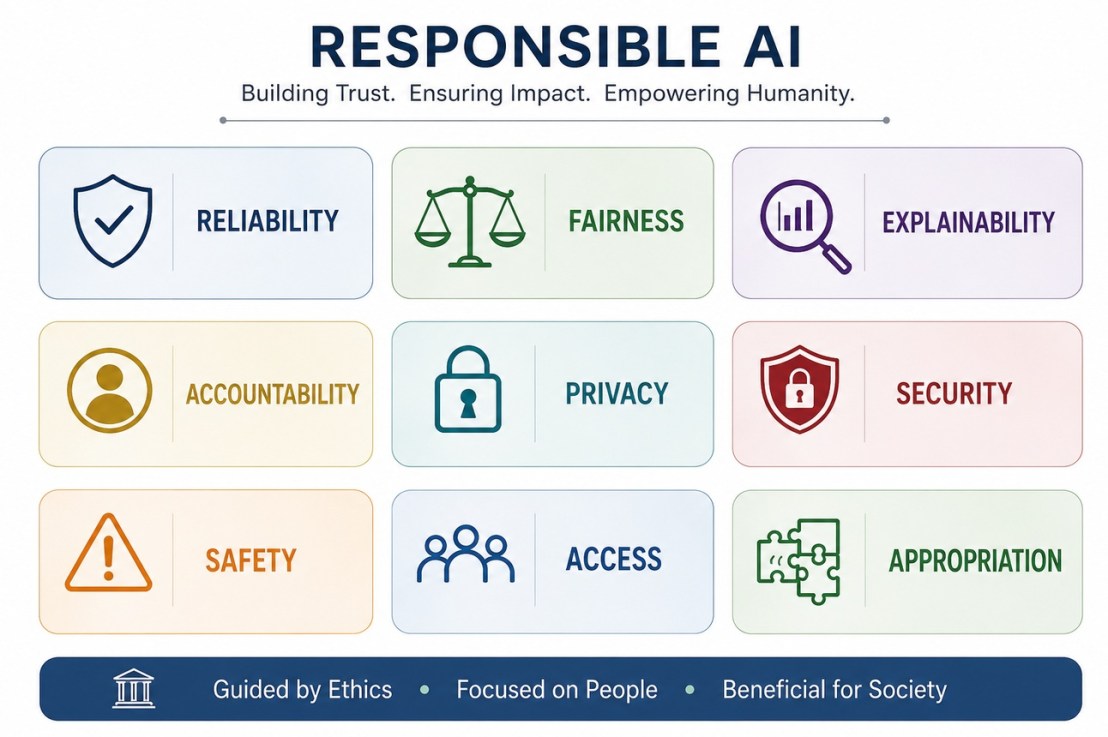
Artificial Intelligence (AI) has rapidly evolved from a niche technological innovation into a foundational capability that influences nearly every aspect of society. Organizations increasingly deploy AI to automate decisions, augment human intelligence, personalize services, improve operational efficiency, and create new business models. AI systems now influence decisions related to healthcare, finance, education, governance, manufacturing, transportation, recruitment, and public safety. While these systems promise unprecedented opportunities for innovation and productivity, they also introduce significant ethical, legal, social, and technical challenges. Poorly designed AI systems can amplify biases, compromise privacy, generate misinformation, make unsafe recommendations, or produce decisions that are difficult to justify. Consequently, the conversation has shifted from merely developing more powerful AI models to ensuring that these models are developed and deployed responsibly. Responsible AI has to be a targeted objective by design and be central to design principles.

Continue reading “Responsible AI: Why the Pillars of Responsible Artificial Intelligence Matter” →
Boosting Small Business Agility with Generative AI

Boosting Small Business Agility with Generative AI

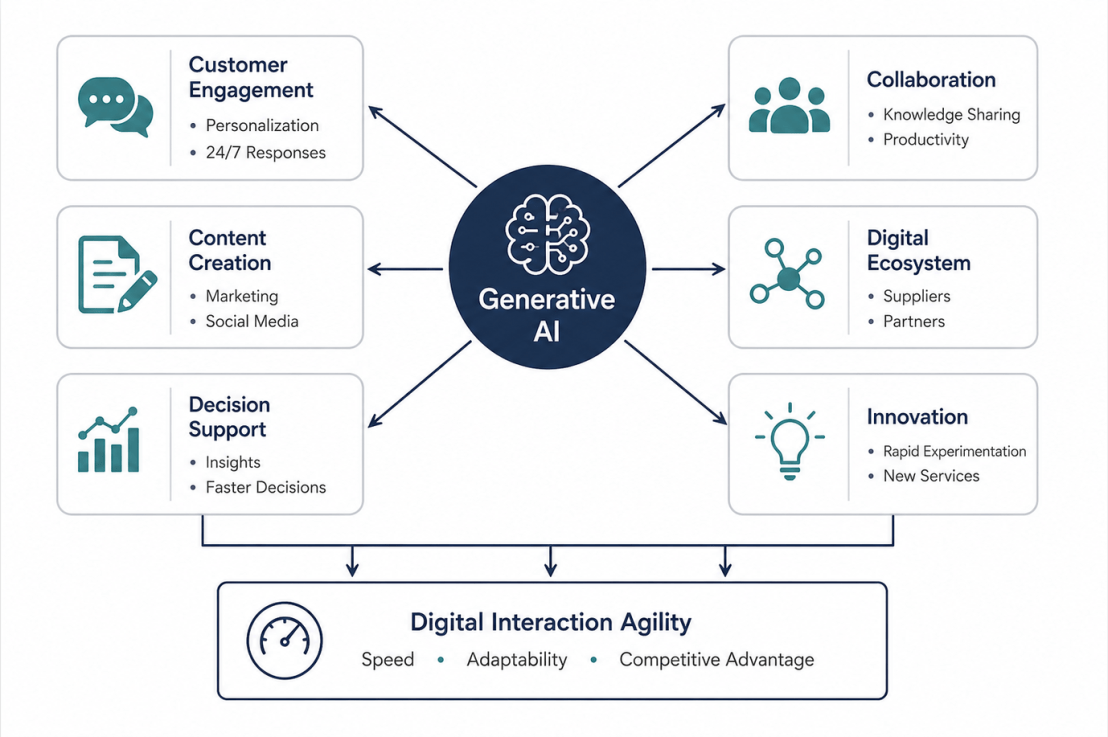
The rapid evolution of digital technologies has fundamentally transformed how businesses interact with customers, suppliers, employees, and other stakeholders. Among these technologies, Generative Artificial Intelligence (Generative AI or GenAI) has emerged as one of the most transformative innovations of the digital era. Unlike earlier artificial intelligence systems that primarily focused on prediction, classification, or automation of repetitive tasks, Generative AI possesses the capability to create human-like text, images, videos, software code, and business insights. This ability has significantly lowered the barriers to digital transformation, particularly for small firms that often struggle with limited financial resources, technical expertise, and workforce capabilities. By democratizing access to advanced cognitive capabilities, Generative AI enables small firms to become more agile in their digital interactions, allowing them to respond quickly to market changes, personalize customer engagement, streamline internal communication, and continuously innovate their business models.

Continue reading “Boosting Small Business Agility with Generative AI” →