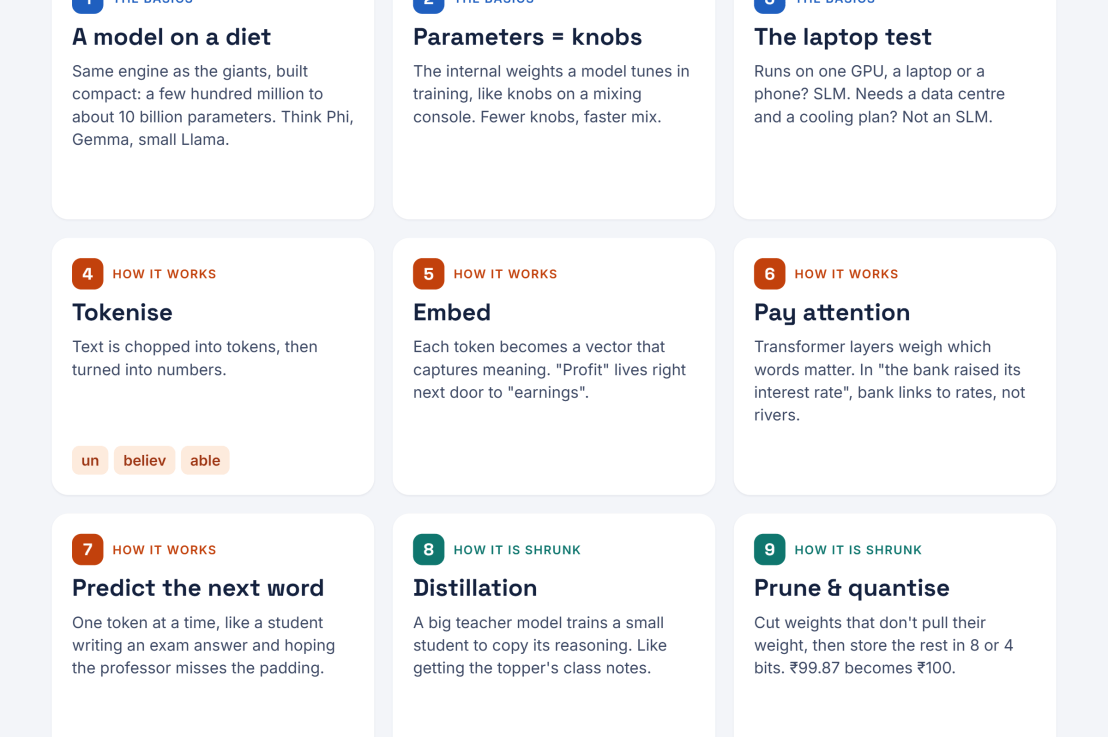
For the last few years, the AI industry has behaved like a teenager at a gym: bigger, bigger, bigger. Every new language model arrived with more parameters, more data and a bigger electricity bill than the last. Then a quiet rebellion began. Researchers started asking a very Indian question: “Kitna deti hai?” How much performance do we actually get for every rupee of compute? The answer gave rise to Small Language Models, or SLMs. These are the compact, fuel-efficient cousins of giant models like GPT or Claude. They will not win a trivia contest against their big relatives, but they can run on your laptop, answer in a blink, and keep your data at home. In this post, let us open the bonnet and see what SLMs are, how they work, and why businesses are suddenly so fond of them.
What Makes a Language Model “Small”?
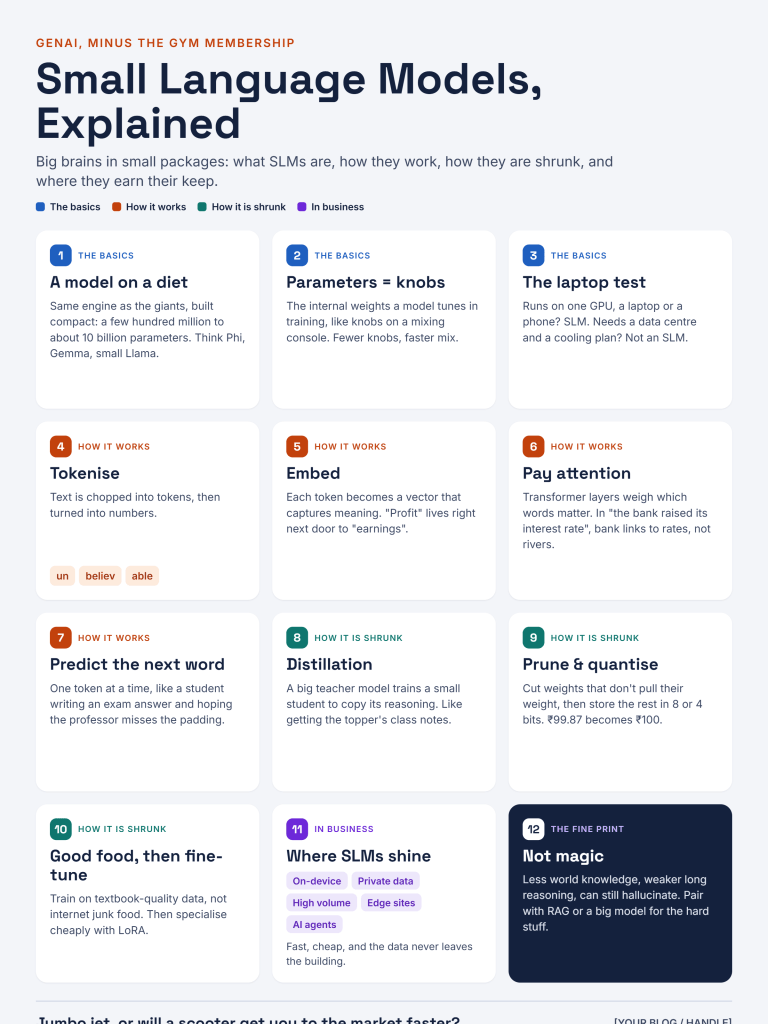
The size of a language model is measured in parameters. Parameters are the internal numbers, or weights, that a model adjusts during training. You can think of them as the knobs on a giant mixing console; tune them well and the model produces sensible language.
Frontier large language models are believed to run into hundreds of billions, even trillions, of parameters. An SLM usually sits somewhere between a few hundred million and roughly ten billion. Well-known examples include Microsoft’s Phi family, Google’s Gemma, the smaller versions of Meta’s Llama, and models from Mistral.
There is no official cut-off line, and the definition keeps shifting as hardware improves. A practical rule of thumb works better: if a model can run comfortably on a single ordinary GPU, a good laptop or even a smartphone, it is in SLM territory. If it needs a data centre and a dedicated cooling plan, it is not.
How an SLM Works Under the Hood
Here is the good news: an SLM works on the same basic principles as its giant cousins. It is not a different species, just a more compact build of the same engine. The process has four steps.
- Tokenisation. Your sentence is first chopped into small pieces called tokens. A token may be a whole word, part of a word or a punctuation mark. “Unbelievable” might become “un”, “believ” and “able”. Each token is then converted into a number the model can work with.
- Embeddings. Each token number is turned into a list of values, called a vector, that captures its meaning. Words with similar meanings, like “profit” and “earnings”, end up close to each other in this mathematical space.
- The transformer layers. These vectors pass through a stack of transformer layers. The key trick here is attention: the model looks at every word in the sentence and works out which other words matter most for understanding it. In “The bank raised its interest rate,” attention helps the model link “bank” with “interest rate” rather than with a river.
- Next-token prediction. Finally, the model predicts the most likely next token, adds it to the text, and repeats. One token at a time, an answer appears, much like a student writing an exam answer word by word while hoping the professor does not notice the padding.
The difference in an SLM is scale. It has fewer layers, smaller vectors and fewer attention heads. That means fewer calculations per word, which is exactly why it is faster and cheaper to run.
How Do You Shrink a Brain?
If an SLM is simply smaller, why isn’t it simply worse? The answer lies in a set of clever techniques that pack more intelligence into fewer parameters.
Knowledge distillation. This is the teacher-student method. A large “teacher” model answers millions of questions, and a small “student” model is trained to imitate not just its final answers but its confidence across possible answers. The student picks up the teacher’s reasoning patterns without needing the teacher’s size. Think of it as getting the topper’s class notes instead of attending every lecture.
High-quality training data. Early models were trained on almost anything scraped from the internet. Many SLMs are instead trained on carefully curated, textbook-quality data. It turns out that a model fed a balanced diet learns more efficiently than one raised on internet junk food.
Pruning. Not every connection in a neural network pulls its weight. Pruning identifies and removes the weights that contribute little, much like trimming a bloated org chart. Done carefully, the model gets leaner without losing much accuracy.
Quantisation. Normally each parameter is stored as a high-precision number using 16 or 32 bits. Quantisation stores it with fewer bits, often 8 or even 4. It is like rounding ₹99.87 to ₹100: you lose a tiny bit of precision but save a lot of memory, and the model runs much faster.
Fine-tuning. Finally, a small general model can be fine-tuned on a specific domain, such as banking regulations, medical notes or customer complaints. Efficient methods like LoRA (Low-Rank Adaptation) update only a small slice of the model, so even a modest team can customise one on a budget.
Where SLMs Shine
For managers, the real question is not “how does it work?” but “where do I use it?” Here are the sweet spots.
- On-device AI. Smartphones, smart cars and wearables can run SLMs locally, so features like summarising messages or live translation work even without a network. Very handy when your train enters a tunnel mid-sentence.
- Privacy-sensitive sectors. Banks, hospitals and government departments can host an SLM on their own servers, so confidential data never travels to an outside cloud.
- High-volume, repetitive tasks. Classifying support tickets, extracting fields from invoices or tagging customer reviews do not need a genius. They need a reliable, fast and cheap worker, which is exactly what an SLM is.
- Edge and low-connectivity settings. In factories, farms or remote branches, a small model running on local hardware keeps working when the internet does not.
- Agentic workflows. In multi-step AI systems, a small model can handle routine sub-tasks while a large model is called only for the hard thinking, cutting costs significantly.
The Fine Print, and the Final Word
SLMs are not magic. With fewer parameters, they store less world knowledge, struggle with long chains of complex reasoning and can still hallucinate confidently. Ask one about an obscure historical event and it may invent a very convincing answer. That is why SLMs are often paired with retrieval systems that feed them fresh, factual documents, or with a larger model that handles the truly difficult questions.
Still, the trend is clear. The future of AI is not one giant brain in the cloud answering everything. It is a team of models, big and small, each doing the job it is best suited for. The small ones will quietly do most of the everyday work, fast, cheap and close to the data.
So the next time someone in a meeting insists that only the biggest model will do, smile politely and ask: “Do we need a jumbo jet, or will a scooter get us to the market faster?”


