Tag: ai

Responsible AI: Why the Pillars of Responsible Artificial Intelligence Matter

Responsible AI: Why the Pillars of Responsible Artificial Intelligence Matter

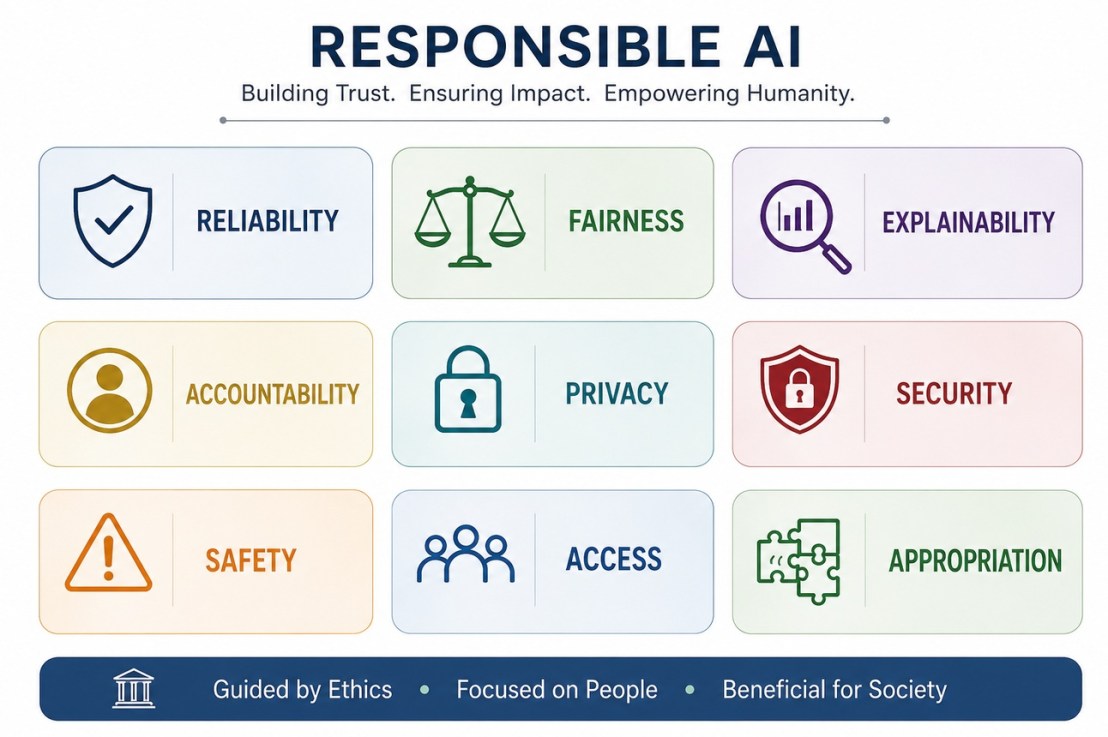
Artificial Intelligence (AI) has rapidly evolved from a niche technological innovation into a foundational capability that influences nearly every aspect of society. Organizations increasingly deploy AI to automate decisions, augment human intelligence, personalize services, improve operational efficiency, and create new business models. AI systems now influence decisions related to healthcare, finance, education, governance, manufacturing, transportation, recruitment, and public safety. While these systems promise unprecedented opportunities for innovation and productivity, they also introduce significant ethical, legal, social, and technical challenges. Poorly designed AI systems can amplify biases, compromise privacy, generate misinformation, make unsafe recommendations, or produce decisions that are difficult to justify. Consequently, the conversation has shifted from merely developing more powerful AI models to ensuring that these models are developed and deployed responsibly. Responsible AI has to be a targeted objective by design and be central to design principles.

Continue reading “Responsible AI: Why the Pillars of Responsible Artificial Intelligence Matter”
Boosting Small Business Agility with Generative AI

Boosting Small Business Agility with Generative AI

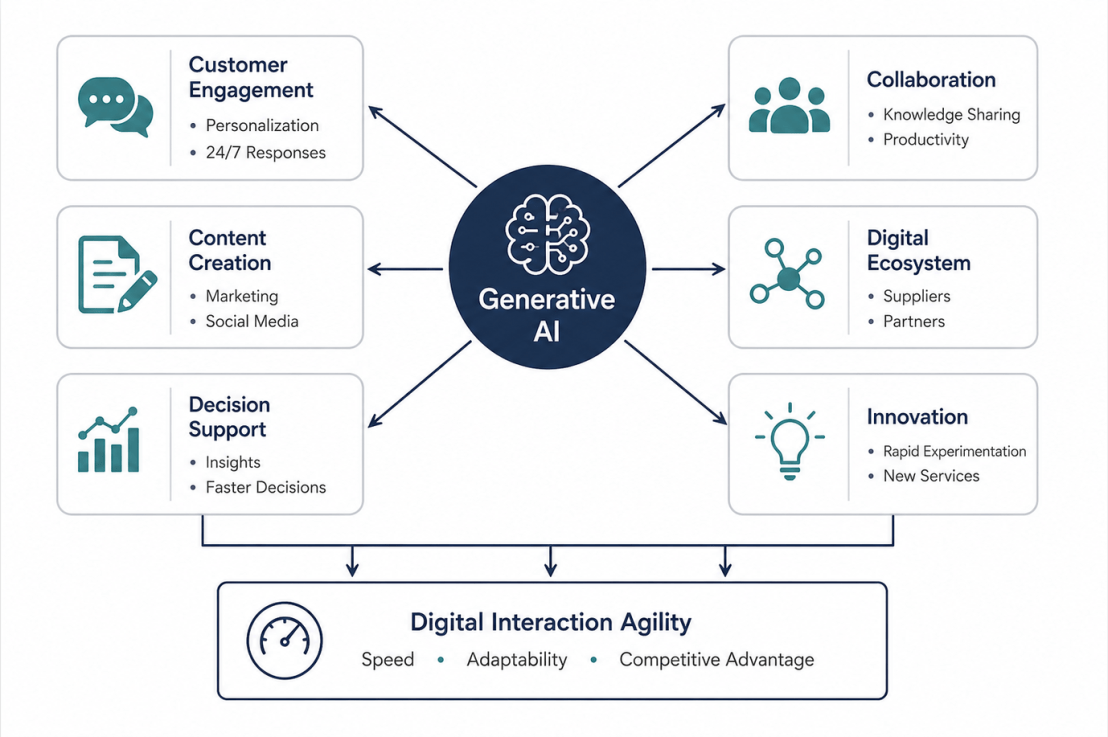
The rapid evolution of digital technologies has fundamentally transformed how businesses interact with customers, suppliers, employees, and other stakeholders. Among these technologies, Generative Artificial Intelligence (Generative AI or GenAI) has emerged as one of the most transformative innovations of the digital era. Unlike earlier artificial intelligence systems that primarily focused on prediction, classification, or automation of repetitive tasks, Generative AI possesses the capability to create human-like text, images, videos, software code, and business insights. This ability has significantly lowered the barriers to digital transformation, particularly for small firms that often struggle with limited financial resources, technical expertise, and workforce capabilities. By democratizing access to advanced cognitive capabilities, Generative AI enables small firms to become more agile in their digital interactions, allowing them to respond quickly to market changes, personalize customer engagement, streamline internal communication, and continuously innovate their business models.

Continue reading “Boosting Small Business Agility with Generative AI”
The Cybersecurity Copilot: How Generative AI Is Reshaping Digital Defense

The Cybersecurity Copilot: How Generative AI Is Reshaping Digital Defense

The history of cybersecurity has largely been a history of reaction. Organizations have invested billions of dollars in firewalls, intrusion detection systems, endpoint protection, identity management, and security operations centers (SOCs), yet cybercriminals have consistently stayed one step ahead. The challenge is no longer the absence of security technologies but the inability of human analysts to process overwhelming volumes of data, identify sophisticated threats, and respond at machine speed. The rise of Generative Artificial Intelligence (GenAI) represents perhaps the most significant opportunity in decades to change this equation. Rather than serving merely as another security tool, GenAI has the potential to become an intelligent collaborator capable of augmenting every stage of the cybersecurity lifecycle.

Continue reading “The Cybersecurity Copilot: How Generative AI Is Reshaping Digital Defense”
Beyond ChatGPT: Understanding the Models Powering the Generative AI Revolution

Beyond ChatGPT: Understanding the Models Powering the Generative AI Revolution

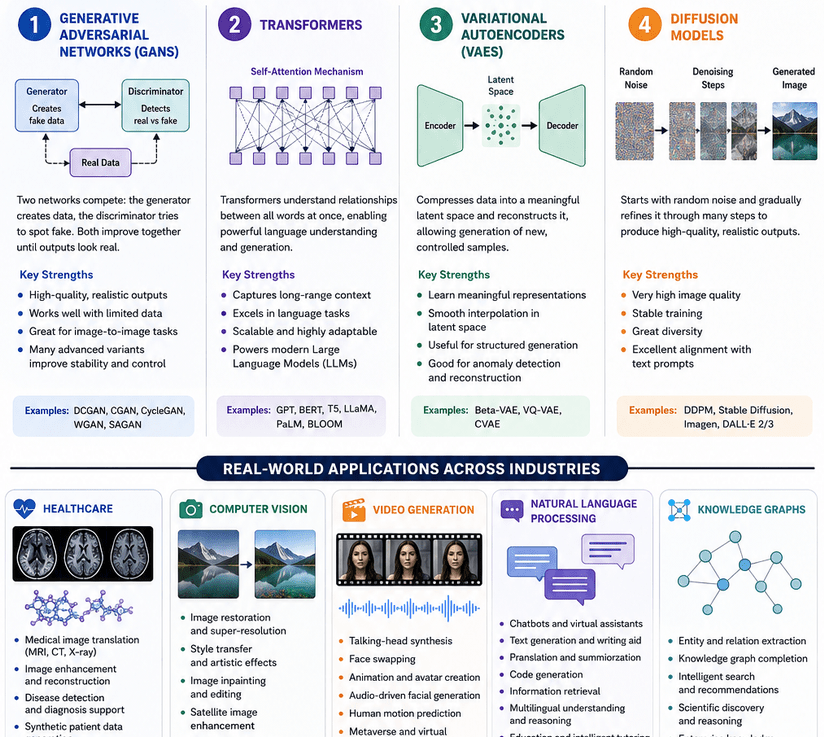
The remarkable success of Generative AI is not driven by a single algorithm but by the evolution of several complementary model architectures, each designed to solve specific computational challenges. Early deep learning systems often struggled with unstable training, poor-quality outputs, limited diversity, and high computational costs. Over the past decade, researchers have progressively addressed these limitations by developing increasingly sophisticated generative models. Today, four dominant architectures—Generative Adversarial Networks (GANs), Transformers, Variational Autoencoders (VAEs), and Diffusion Models—form the technological backbone of modern Generative AI. Each architecture approaches content generation differently and has distinct strengths that make it suitable for particular applications ranging from computer vision and language processing to scientific research and healthcare.

Continue reading “Beyond ChatGPT: Understanding the Models Powering the Generative AI Revolution”
Why Users Should Verify Official Websites Before Installing Productivity and Messaging Apps

Why Users Should Verify Official Websites Before Installing Productivity and Messaging Apps

Installing software has become a normal part of daily digital life. People download productivity tools for documents, spreadsheets, and presentations. They also install messaging apps for team communication, private chats, online communities, and cross-device conversations. Because these apps often handle personal data, files, contacts, and account information, users should be careful before downloading or installing anything.

Continue reading “Why Users Should Verify Official Websites Before Installing Productivity and Messaging Apps”

Why go for Responsible Artificial Intelligence frameworks during Digital Transformation

For firms, pursuing responsible AI is no longer a matter of public relations or ethical signaling—it is becoming a core strategic decision that shapes long-term competitiveness, risk exposure, and organizational credibility. As artificial intelligence moves from experimental use to mission-critical deployment, the question is not simply whether firms should adopt AI, but how they should design, govern, and integrate it into their operations in a way that is both effective and trustworthy.

Continue reading “Why go for Responsible Artificial Intelligence frameworks during Digital Transformation”
Why Growing Companies are Shifting Away from Traditional In-House IT

Why Growing Companies are Shifting Away from Traditional In-House IT

As a business scales, its operational needs become exponentially more complex. What begins as a manageable technical setup quickly evolves into a sprawling infrastructure requiring constant oversight. For years, the default solution for growing companies was to build a dedicated, in-house IT department. However, this traditional approach is increasingly proving to be a bottleneck rather than a strategic advantage. Today’s dynamic business environment demands agility, robust security, and specialised expertise, prompting business leaders to rethink how they manage their digital operations. The speed of technological advancement simply outpaces the capacity of most internal teams to adapt organically.

Continue reading “Why Growing Companies are Shifting Away from Traditional In-House IT”

Which IT roles will AI automate most

Specific IT roles are likely to be replaced with the advent of generative artificial intelligence. We wanted to undertake a brief survey of which roles are likely to be more impacted and hence, professionals in these roles should look into reskilling their portfolio and competency. Reskilling in AI/ML use could be a way to strengthen competency within this area itself.

Continue reading “Which IT roles will AI automate most”

What is Prompt Engineering: An overview

Prompt engineering refers to the practice of designing and structuring inputs to large language models so that they produce accurate, useful, and reliable outputs. As language models have grown more capable, the way prompts are written has become an important skill, blending aspects of linguistics, logic, and problem formulation. Over time, several distinct types of prompt engineering have emerged, each suited to different tasks and levels of model guidance. The following discussion presents the main types of prompt engineering in an essay-style narrative, with an example woven into each explanation.

Continue reading “What is Prompt Engineering: An overview”