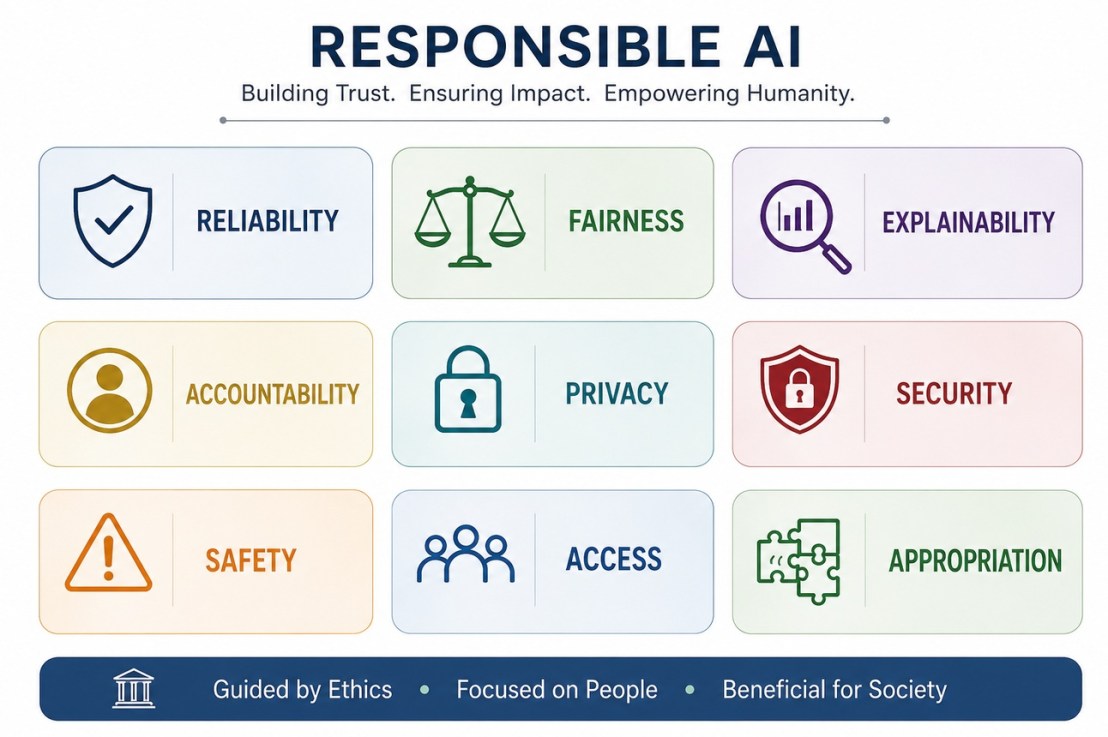
Artificial Intelligence (AI) has rapidly evolved from a niche technological innovation into a foundational capability that influences nearly every aspect of society. Organizations increasingly deploy AI to automate decisions, augment human intelligence, personalize services, improve operational efficiency, and create new business models. AI systems now influence decisions related to healthcare, finance, education, governance, manufacturing, transportation, recruitment, and public safety. While these systems promise unprecedented opportunities for innovation and productivity, they also introduce significant ethical, legal, social, and technical challenges. Poorly designed AI systems can amplify biases, compromise privacy, generate misinformation, make unsafe recommendations, or produce decisions that are difficult to justify. Consequently, the conversation has shifted from merely developing more powerful AI models to ensuring that these models are developed and deployed responsibly. Responsible AI has to be a targeted objective by design and be central to design principles.
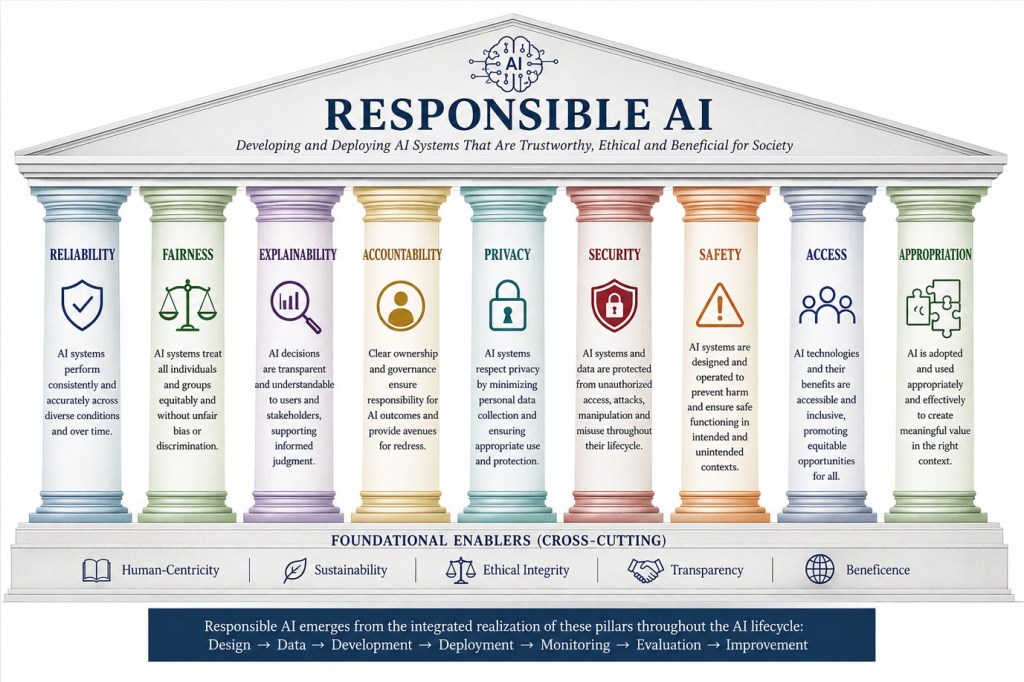
Responsible AI refers to the design, development, deployment, and governance of AI systems that align with human values, ethical principles, and societal expectations while minimizing harm and maximizing benefits. Rather than treating ethics as an afterthought, Responsible AI integrates ethical considerations throughout the AI lifecycle—from data collection and model development to deployment, monitoring, and retirement. Several interrelated pillars collectively establish the foundation of Responsible AI. These include reliability, fairness, explainability, accountability, privacy, security, safety, access, and appropriation. Each pillar addresses a unique dimension of trustworthy AI while complementing the others to create systems that society can confidently adopt.
Reliability
Reliability represents one of the most fundamental pillars of Responsible AI because users expect AI systems to perform consistently across different situations. A reliable AI system generates stable, accurate, and dependable outputs under varying operational conditions. Organizations increasingly rely on AI for mission-critical applications such as medical diagnosis, autonomous vehicles, industrial automation, and financial forecasting. In these settings, unreliable outputs can lead to severe financial losses, reputational damage, or even loss of life. Reliability requires rigorous testing, validation across diverse datasets, continuous monitoring, and mechanisms for detecting performance degradation over time. AI models often suffer from concept drift, where changing real-world conditions reduce prediction accuracy. Responsible AI therefore demands continuous retraining and evaluation rather than assuming that a model remains effective indefinitely. Reliable AI builds user confidence because stakeholders know that system behavior remains predictable even under uncertain conditions.
Fairness
Fairness addresses one of the most widely discussed ethical concerns surrounding AI. AI systems learn from historical data, and if these datasets contain societal biases, the resulting models may perpetuate or even amplify discrimination. Examples include biased hiring systems favoring certain demographic groups, credit scoring algorithms disadvantaging marginalized populations, or predictive policing systems reinforcing historical inequities. Fairness requires identifying, measuring, and mitigating biases throughout the AI lifecycle. This includes ensuring representative datasets, applying bias detection techniques, evaluating outcomes across different demographic groups, and regularly auditing deployed systems. Fairness is not merely a technical objective but also a societal one because different stakeholders may define fairness differently depending on context. The importance of fairness extends beyond ethical obligations. Organizations deploying biased AI systems may face legal consequences, regulatory scrutiny, public backlash, and declining customer trust. Fair AI supports social inclusion, equal opportunity, and equitable treatment while reinforcing organizational legitimacy.
Explainability
Many modern AI models, particularly deep learning systems and large language models, operate as “black boxes,” making highly accurate predictions without clearly revealing how those decisions are reached. Explainability seeks to bridge this gap by enabling humans to understand the reasoning behind AI-generated decisions. Explainability is particularly important in high-stakes environments such as healthcare, judicial systems, insurance, and finance, where individuals have the right to understand decisions that affect their lives. Physicians need to understand why an AI recommends a specific diagnosis. Loan applicants deserve explanations for credit approval or rejection. Judges using AI-assisted tools require transparency regarding sentencing recommendations. Explainability enhances trust, facilitates debugging, supports regulatory compliance, and enables meaningful human oversight. It also helps developers identify hidden biases, incorrect assumptions, or unexpected model behaviors. While highly complex AI models often achieve greater predictive performance, Responsible AI emphasizes balancing predictive accuracy with sufficient interpretability to ensure informed decision-making.
Accountability
AI systems do not operate independently of human organizations. Every AI application is designed, trained, deployed, and maintained by individuals or institutions. Accountability therefore establishes clear responsibility for AI outcomes and ensures that organizations remain answerable for the consequences of AI-assisted decisions. Without accountability, harmful outcomes may be dismissed as the fault of “the algorithm,” creating governance gaps where no stakeholder assumes responsibility. Responsible AI requires organizations to define governance structures, assign ownership for AI systems, document development decisions, maintain audit trails, and establish procedures for addressing failures or unintended consequences. Accountability also involves human oversight. Humans should retain meaningful authority over critical AI decisions, particularly where ethical judgment or contextual understanding is required. Effective accountability mechanisms foster transparency, encourage responsible innovation, and provide pathways for redress when AI systems cause harm.
Privacy
AI systems rely heavily on large volumes of data, much of which contains sensitive personal information. Privacy therefore becomes an essential pillar of Responsible AI because individuals have fundamental rights regarding how their data is collected, processed, stored, and shared. Privacy extends beyond simply protecting confidential information. It includes obtaining informed consent, minimizing unnecessary data collection, anonymizing datasets where appropriate, implementing privacy-preserving machine learning techniques, and ensuring compliance with evolving data protection regulations. Technologies such as differential privacy, federated learning, and secure multi-party computation increasingly enable AI development while reducing privacy risks. Protecting privacy strengthens public confidence in AI systems. Individuals are more willing to adopt AI-powered services when they trust that their personal information will not be misused or exposed. Conversely, privacy violations can lead to legal penalties, financial losses, and lasting damage to organizational reputation.
Security
As AI becomes embedded within critical infrastructure, cybersecurity, financial systems, healthcare, and national defense, protecting AI systems against malicious attacks becomes increasingly important. Security ensures that AI models, datasets, infrastructure, and outputs remain protected against unauthorized access, manipulation, or sabotage. AI systems face unique security threats. Attackers may manipulate training data through data poisoning, craft adversarial examples that deceive models, steal proprietary models, or exploit vulnerabilities in AI deployment pipelines. Compromised AI systems may generate incorrect recommendations or expose sensitive information. Responsible AI therefore requires robust cybersecurity practices, including secure software development, encrypted data storage, authentication mechanisms, continuous monitoring, vulnerability assessments, and incident response planning. Security safeguards not only organizational assets but also public trust in AI technologies.
Safety
Safety by design ensures that AI systems avoid causing physical, psychological, financial, or societal harm, even under unexpected conditions. As AI increasingly interacts with the physical world through autonomous vehicles, robotics, healthcare devices, and industrial automation, ensuring safe behavior becomes indispensable. Safety requires identifying potential hazards before deployment, conducting extensive risk assessments, testing edge cases, implementing fail-safe mechanisms, and maintaining human intervention capabilities when necessary. Safety also encompasses minimizing harmful content generated by AI, reducing misinformation, preventing manipulation, and protecting vulnerable users. Unlike reliability, which focuses primarily on consistent performance, safety emphasizes preventing unacceptable consequences even when systems encounter unforeseen circumstances. Safe AI protects both individual users and society from unintended harms while supporting sustainable technological adoption.
Access
Responsible AI should promote equitable access to AI technologies rather than concentrating benefits among a small number of organizations or privileged populations. Access encompasses affordability, usability, inclusiveness, digital literacy, language accessibility, and accommodation for individuals with disabilities. AI has enormous potential to reduce educational inequalities, improve healthcare delivery, support small businesses, and enhance public services. However, unequal access may widen existing digital divides, leaving disadvantaged communities unable to benefit from technological advances. Promoting access requires designing inclusive AI systems that accommodate diverse languages, cultures, educational backgrounds, and technological capabilities. It also involves investing in digital infrastructure, AI education, workforce development, and affordable computing resources. Democratizing access ensures that AI contributes to broad societal progress rather than reinforcing existing inequalities.
Appropriation
Appropriation refers to the responsible adoption, adaptation, and integration of AI within organizational and societal contexts. AI generates value not merely because sophisticated algorithms exist, but because individuals and organizations use these technologies appropriately to achieve meaningful objectives. Even technically excellent AI systems may fail if users misunderstand their capabilities, over-rely on automated outputs, or employ AI in unsuitable contexts. Responsible appropriation emphasizes aligning AI deployment with organizational goals, ethical values, regulatory requirements, and user capabilities. It requires educating users about AI limitations, encouraging critical thinking rather than blind reliance, and designing workflows that complement rather than replace human expertise. Human-AI collaboration often produces superior outcomes compared to either humans or AI working independently. Appropriation also recognizes that AI implementation differs across industries, cultures, and organizational environments. Responsible adoption therefore requires contextual adaptation, stakeholder engagement, continuous learning, and ongoing evaluation of AI’s real-world impacts. Organizations that appropriate AI responsibly are better positioned to realize sustainable value while minimizing unintended consequences.
Conclusion
Responsible AI represents a comprehensive governance philosophy that ensures artificial intelligence advances human well-being while minimizing risks. The nine pillars—reliability, fairness, explainability, accountability, privacy, security, safety, access, and appropriation—collectively establish the foundations of trustworthy AI. Each pillar addresses distinct but interconnected challenges, ranging from technical robustness and cybersecurity to ethical governance and equitable societal adoption. No single pillar alone is sufficient. Reliable systems without fairness may reinforce discrimination. Explainable systems without security remain vulnerable to attacks. Accessible AI without privacy protections may expose sensitive information. Likewise, technically sound AI delivers limited value if organizations fail to appropriate it responsibly within their operational and ethical contexts. As AI capabilities continue to expand, Responsible AI will become increasingly central to organizational strategy, public policy, and technological innovation. Organizations that embed these pillars throughout the AI lifecycle will not only comply with evolving regulatory expectations but also cultivate stakeholder trust, improve long-term sustainability, and unlock the transformative potential of AI in ways that are ethical, transparent, and beneficial for society.


You must be logged in to post a comment.