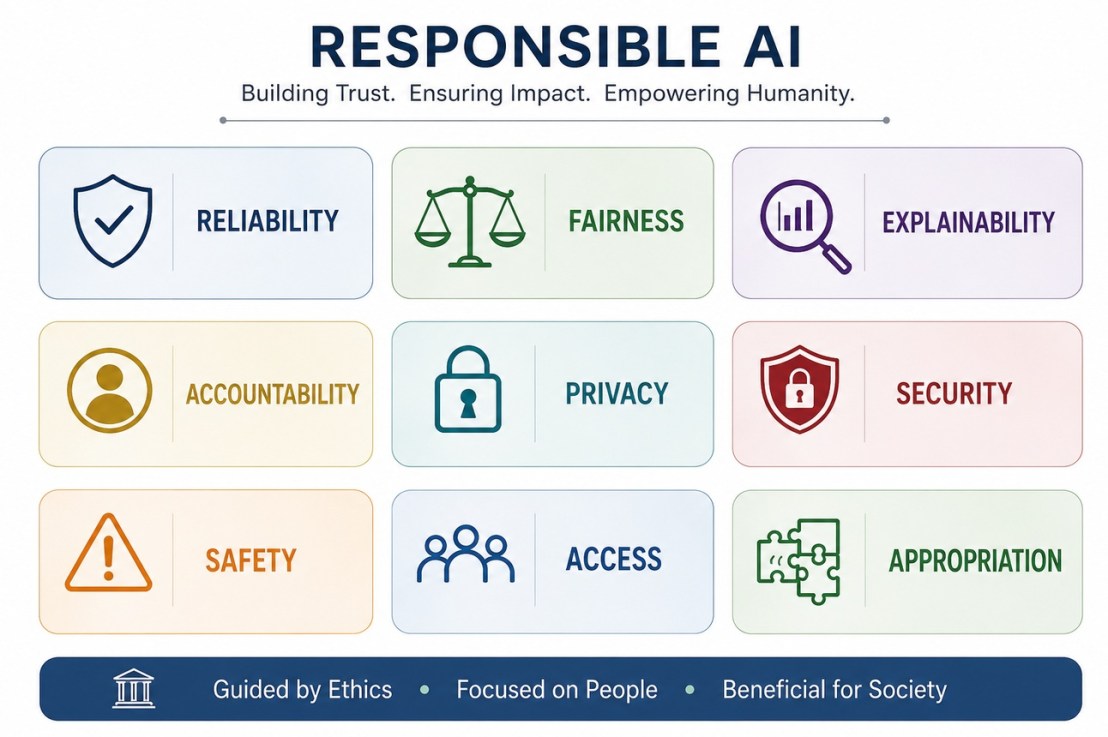
Artificial Intelligence (AI) has rapidly evolved from a niche technological innovation into a foundational capability that influences nearly every aspect of society. Organizations increasingly deploy AI to automate decisions, augment human intelligence, personalize services, improve operational efficiency, and create new business models. AI systems now influence decisions related to healthcare, finance, education, governance, manufacturing, transportation, recruitment, and public safety. While these systems promise unprecedented opportunities for innovation and productivity, they also introduce significant ethical, legal, social, and technical challenges. Poorly designed AI systems can amplify biases, compromise privacy, generate misinformation, make unsafe recommendations, or produce decisions that are difficult to justify. Consequently, the conversation has shifted from merely developing more powerful AI models to ensuring that these models are developed and deployed responsibly. Responsible AI has to be a targeted objective by design and be central to design principles.
Continue reading “Responsible AI: Why the Pillars of Responsible Artificial Intelligence Matter”Category: Technology Governance
Boosting Small Business Agility with Generative AI
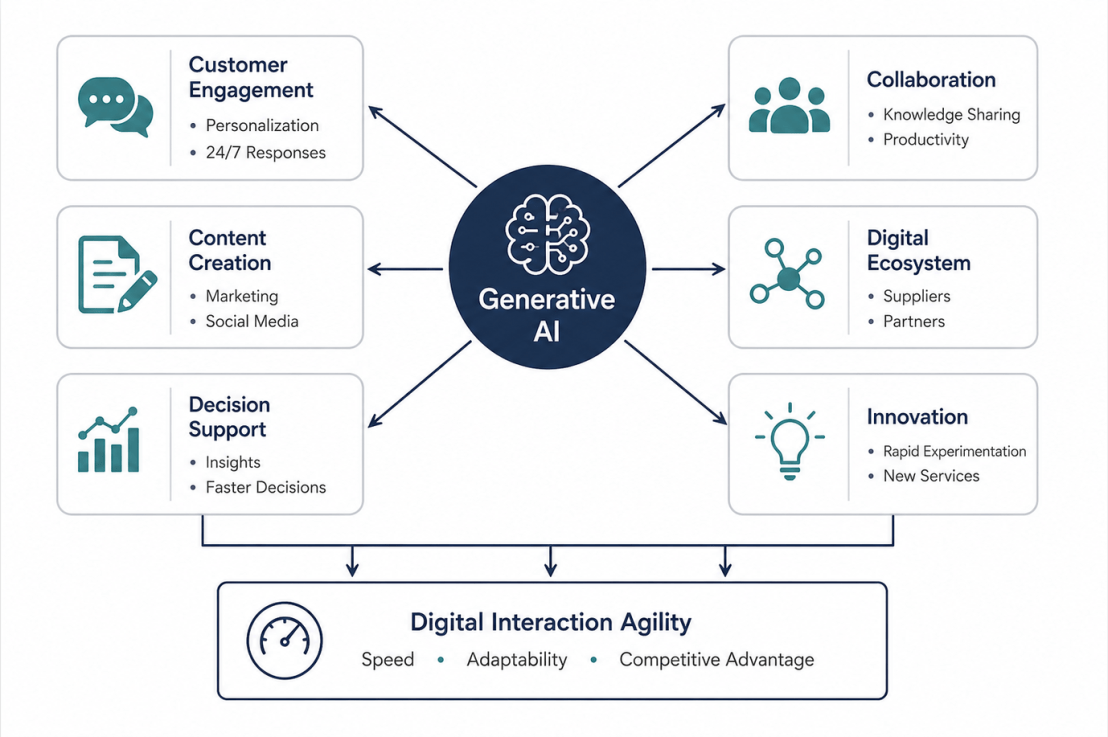
The rapid evolution of digital technologies has fundamentally transformed how businesses interact with customers, suppliers, employees, and other stakeholders. Among these technologies, Generative Artificial Intelligence (Generative AI or GenAI) has emerged as one of the most transformative innovations of the digital era. Unlike earlier artificial intelligence systems that primarily focused on prediction, classification, or automation of repetitive tasks, Generative AI possesses the capability to create human-like text, images, videos, software code, and business insights. This ability has significantly lowered the barriers to digital transformation, particularly for small firms that often struggle with limited financial resources, technical expertise, and workforce capabilities. By democratizing access to advanced cognitive capabilities, Generative AI enables small firms to become more agile in their digital interactions, allowing them to respond quickly to market changes, personalize customer engagement, streamline internal communication, and continuously innovate their business models.
Continue reading “Boosting Small Business Agility with Generative AI”The Cybersecurity Copilot: How Generative AI Is Reshaping Digital Defense
The history of cybersecurity has largely been a history of reaction. Organizations have invested billions of dollars in firewalls, intrusion detection systems, endpoint protection, identity management, and security operations centers (SOCs), yet cybercriminals have consistently stayed one step ahead. The challenge is no longer the absence of security technologies but the inability of human analysts to process overwhelming volumes of data, identify sophisticated threats, and respond at machine speed. The rise of Generative Artificial Intelligence (GenAI) represents perhaps the most significant opportunity in decades to change this equation. Rather than serving merely as another security tool, GenAI has the potential to become an intelligent collaborator capable of augmenting every stage of the cybersecurity lifecycle.
Continue reading “The Cybersecurity Copilot: How Generative AI Is Reshaping Digital Defense”


You must be logged in to post a comment.