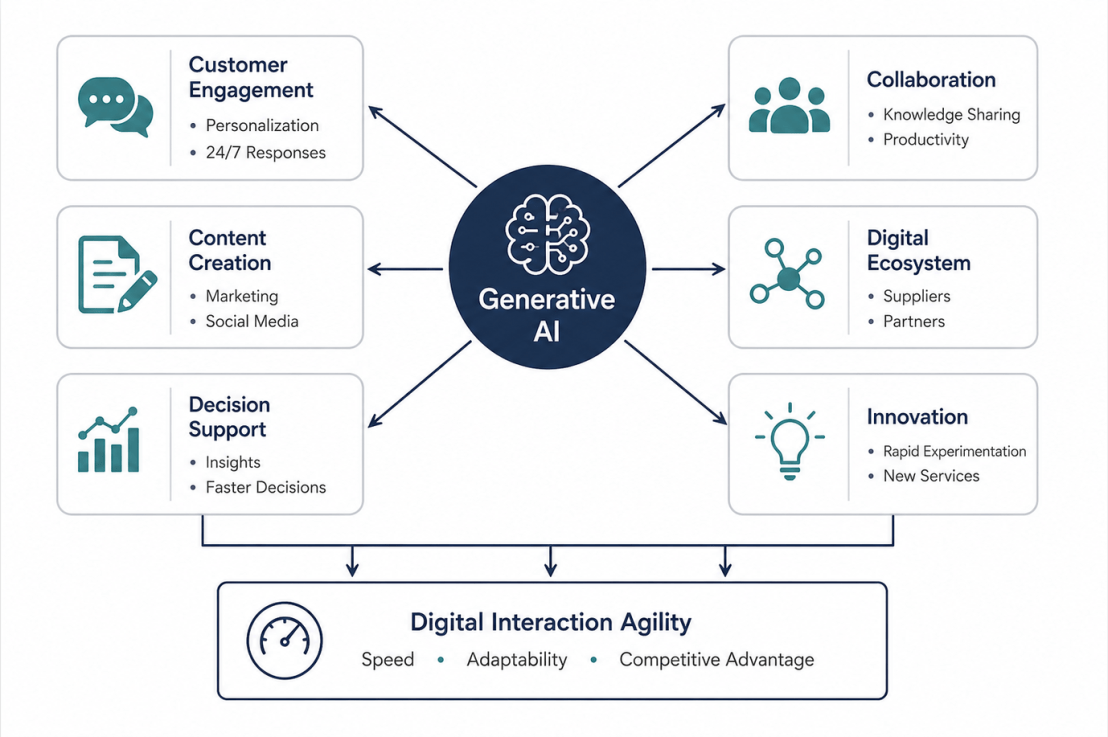
The rapid evolution of digital technologies has fundamentally transformed how businesses interact with customers, suppliers, employees, and other stakeholders. Among these technologies, Generative Artificial Intelligence (Generative AI or GenAI) has emerged as one of the most transformative innovations of the digital era. Unlike earlier artificial intelligence systems that primarily focused on prediction, classification, or automation of repetitive tasks, Generative AI possesses the capability to create human-like text, images, videos, software code, and business insights. This ability has significantly lowered the barriers to digital transformation, particularly for small firms that often struggle with limited financial resources, technical expertise, and workforce capabilities. By democratizing access to advanced cognitive capabilities, Generative AI enables small firms to become more agile in their digital interactions, allowing them to respond quickly to market changes, personalize customer engagement, streamline internal communication, and continuously innovate their business models.
Digital interaction agility refers to an organization’s capability to rapidly sense changes in its environment, adapt communication strategies, and effectively engage stakeholders across digital platforms. For small firms, agility has always been a competitive necessity because they lack the economies of scale enjoyed by large enterprises. Traditionally, however, achieving digital agility required investments in sophisticated customer relationship management systems, marketing automation platforms, analytics tools, and skilled personnel. Generative AI fundamentally changes this equation by embedding intelligence directly into everyday business processes, making advanced digital capabilities accessible at relatively low cost.
One of the most significant ways Generative AI enhances agility is through intelligent customer communication. Customers today expect businesses to provide immediate, personalized, and consistent responses across multiple digital channels including websites, email, social media, and messaging applications. Small firms often lack dedicated customer support teams capable of maintaining continuous engagement. Generative AI-powered conversational agents overcome this limitation by providing instant responses to customer inquiries, generating personalized product recommendations, handling routine service requests, and escalating complex issues when necessary. These systems continuously learn from interactions, allowing firms to improve service quality without proportionally increasing staffing costs. Consequently, small businesses become capable of offering customer experiences that rival those of much larger organizations.
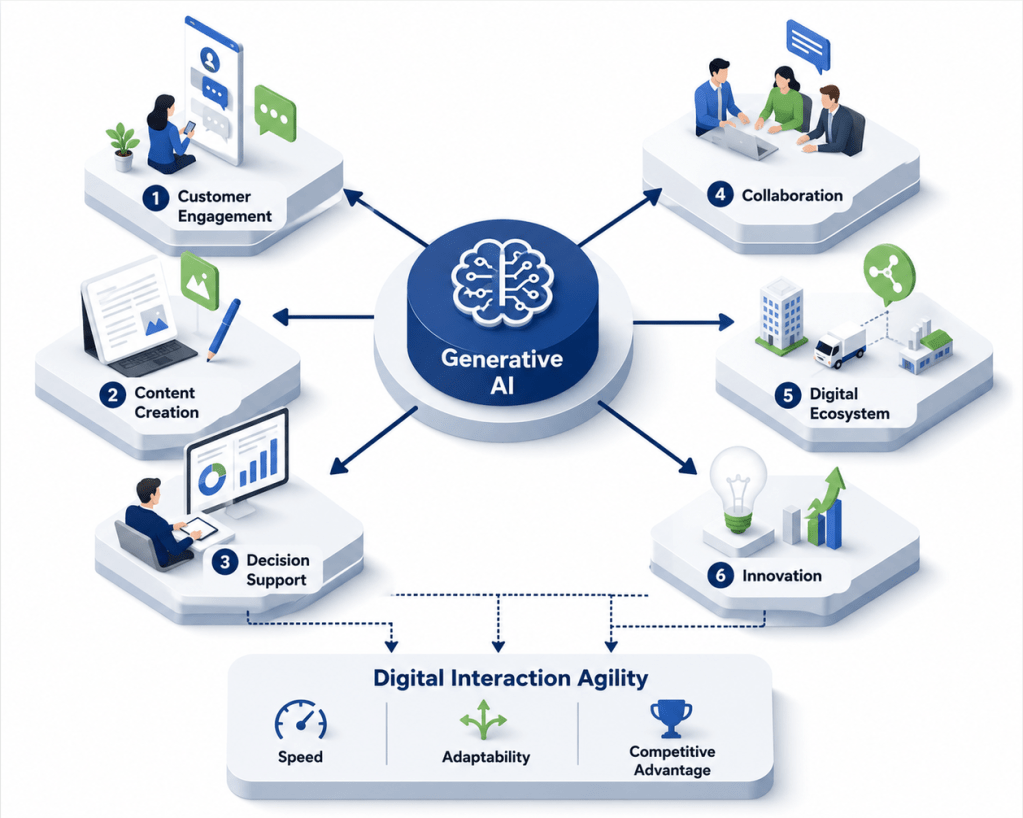
Personalization further strengthens digital interaction agility. Modern customers expect firms to understand their preferences, purchase histories, and individual requirements. Generative AI analyzes customer data and generates highly customized communications, promotional messages, product descriptions, and follow-up interactions. Rather than relying on standardized marketing campaigns, small firms can produce individualized content for thousands of customers simultaneously. This capability enables businesses to rapidly adapt marketing messages based on customer behavior, seasonal trends, or emerging market conditions. Personalized interactions increase customer satisfaction, strengthen loyalty, and improve conversion rates while requiring significantly fewer human resources.
Generative AI also transforms content creation, one of the most resource-intensive activities for small firms operating in digital markets. Maintaining active digital engagement requires a constant flow of high-quality content including blogs, social media posts, newsletters, advertisements, product descriptions, instructional materials, and website updates. Traditionally, producing such content demanded skilled writers, designers, and marketing professionals. Generative AI dramatically accelerates content generation by producing well-structured drafts, creating visual designs, translating content into multiple languages, and adapting messages for different audience segments. As a result, small firms can maintain an active digital presence and rapidly respond to emerging opportunities without expanding their marketing departments.
Another important dimension of agility lies in decision-making speed. Digital interactions generate enormous volumes of structured and unstructured data through customer feedback, online reviews, social media conversations, emails, and transaction records. Small firms often struggle to extract actionable insights from these diverse information sources because of limited analytical capabilities. Generative AI assists managers by summarizing customer feedback, identifying emerging themes, generating analytical reports, and explaining complex market trends in understandable language. Instead of spending days manually reviewing customer comments, business owners can obtain comprehensive insights within minutes. Faster interpretation of digital information enables quicker strategic adjustments and more responsive customer engagement.
Internal collaboration also becomes considerably more agile with Generative AI. Small firms frequently operate with lean organizational structures where employees perform multiple roles simultaneously. Effective communication and knowledge sharing therefore become essential for operational efficiency. Generative AI assists employees by drafting emails, preparing meeting summaries, generating project documentation, creating training materials, and organizing institutional knowledge. Routine administrative tasks consume less employee time, allowing staff to focus on higher-value activities such as innovation, customer relationships, and strategic planning. Improved collaboration enhances organizational responsiveness and facilitates quicker execution of business decisions.
Generative AI further supports agility by enabling rapid experimentation and innovation. Small firms often hesitate to test new products, marketing strategies, or customer engagement approaches because experimentation traditionally requires considerable investments in design, development, and evaluation. Generative AI significantly lowers these costs by generating prototype designs, marketing campaigns, business proposals, software code, and product concepts within minutes. Firms can quickly evaluate multiple alternatives, collect customer feedback, and refine offerings before making substantial investments. This iterative experimentation enables continuous innovation while reducing business risk.
The technology also enhances supply chain and partner interactions. Small firms increasingly rely on digital ecosystems involving suppliers, logistics providers, distributors, and financial institutions. Generative AI simplifies these interactions by automatically drafting procurement communications, summarizing contracts, generating compliance documents, translating international correspondence, and supporting negotiations through intelligent document preparation. Faster coordination with external partners reduces delays and enables firms to respond more effectively to supply chain disruptions or changing customer demand.
Social media engagement represents another critical area where Generative AI improves digital agility. Digital platforms operate continuously, with trends evolving rapidly across industries. Small firms often lack the dedicated marketing teams needed to monitor conversations and respond promptly. Generative AI assists by generating platform-specific content, recommending hashtags, analyzing audience sentiment, responding to customer comments, and identifying trending topics relevant to the business. Consequently, firms maintain consistent engagement with online communities while adapting communication strategies in near real time.
Despite these substantial benefits, Generative AI also introduces important managerial challenges. The quality of AI-generated content depends heavily on the quality of input data and prompt design. Inaccurate or biased outputs may negatively affect customer trust if deployed without human oversight. Small firms must therefore establish governance mechanisms to review AI-generated communications, particularly when dealing with legal, financial, or highly personalized customer interactions. Data privacy, intellectual property protection, and regulatory compliance also become increasingly important as firms integrate AI into customer-facing activities. Managers must ensure that customer data are handled responsibly and that AI-generated outputs align with organizational values and applicable regulations.
Furthermore, organizational agility enabled by Generative AI requires complementary investments in employee capabilities. Rather than replacing human expertise, Generative AI augments employee productivity by automating routine cognitive tasks. Employees need skills in prompt engineering, critical evaluation of AI outputs, digital literacy, and responsible AI usage. Developing these competencies allows firms to fully leverage AI while maintaining human judgment, creativity, and ethical decision-making. Organizations that successfully combine human expertise with AI capabilities are likely to achieve sustainable competitive advantages.
In conclusion, Generative AI represents a powerful catalyst for digital interaction agility among small firms. By democratizing access to advanced cognitive capabilities, it enables businesses to deliver personalized customer experiences, generate digital content efficiently, accelerate decision-making, strengthen internal collaboration, enhance partner interactions, and foster continuous innovation. Unlike previous waves of digital transformation that often favored resource-rich organizations, Generative AI significantly lowers the cost and complexity of adopting intelligent business practices. While challenges related to governance, ethics, and workforce development remain important, firms that strategically integrate Generative AI into their digital interactions can become more adaptive, resilient, and competitive. As digital ecosystems continue to evolve, Generative AI will increasingly serve not merely as an automation tool but as a strategic capability that empowers small firms to sense opportunities, respond rapidly to environmental changes, and create sustained value through agile digital engagement.


You must be logged in to post a comment.