Beyond ChatGPT: Understanding the Models Powering the Generative AI Revolution
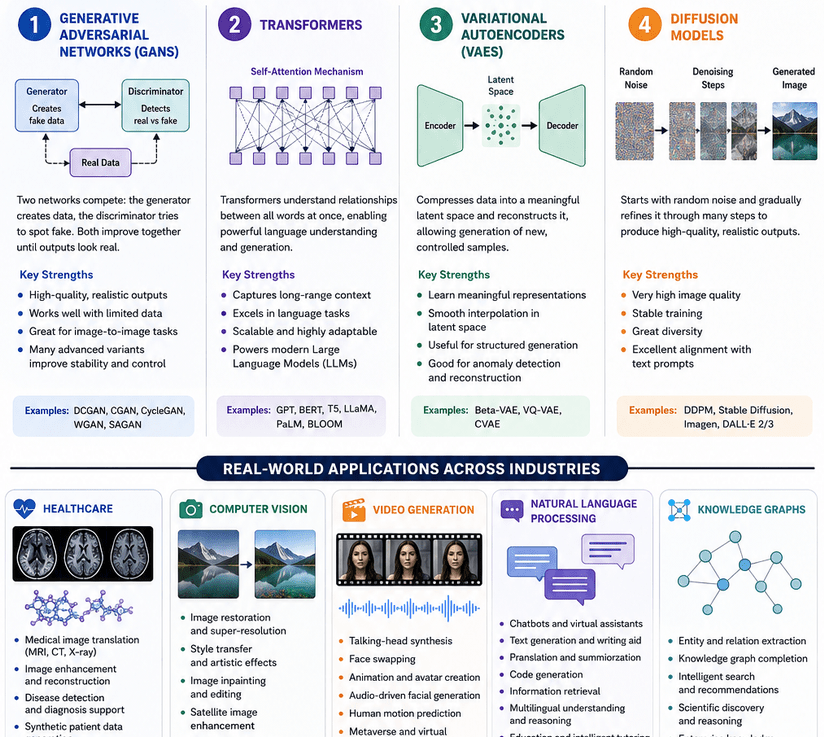
The remarkable success of Generative AI is not driven by a single algorithm but by the evolution of several complementary model architectures, each designed to solve specific computational challenges. Early deep learning systems often struggled with unstable training, poor-quality outputs, limited diversity, and high computational costs. Over the past decade, researchers have progressively addressed these limitations by developing increasingly sophisticated generative models. Today, four dominant architectures—Generative Adversarial Networks (GANs), Transformers, Variational Autoencoders (VAEs), and Diffusion Models—form the technological backbone of modern Generative AI. Each architecture approaches content generation differently and has distinct strengths that make it suitable for particular applications ranging from computer vision and language processing to scientific research and healthcare.
Artificial Intelligence has entered an exciting new phase, moving far beyond systems that simply recognize patterns or classify information. The emergence of Generative Artificial Intelligence (GenAI) has transformed AI from an analytical technology into a creative one capable of producing text, images, videos, music, software code, scientific discoveries, and even molecular structures. Unlike conventional machine learning algorithms that focus on prediction or classification, generative models learn the underlying probability distributions of data and create entirely new content that closely resembles real-world examples. This breakthrough has fundamentally altered how researchers, businesses, educators, healthcare professionals, and governments perceive the role of artificial intelligence. A recent systematic review of Generative AI synthesizes the rapid advancements in this field and highlights how multiple generative architectures have evolved to solve diverse real-world problems while simultaneously raising new ethical and governance challenges.
Generative Adversarial Networks represent one of the earliest breakthroughs in modern Generative AI. Introduced through the innovative concept of adversarial learning, GANs consist of two competing neural networks: a Generator that attempts to create realistic synthetic data and a Discriminator that attempts to distinguish generated content from genuine data. Through continuous competition, both networks improve simultaneously until the generated outputs become nearly indistinguishable from real-world examples. This adversarial learning strategy has enabled GANs to produce highly realistic images while requiring relatively limited manually annotated training data. As research progressed, several variants such as Deep Convolutional GAN (DCGAN), Conditional GAN (CGAN), Wasserstein GAN (WGAN), Self-Attention GAN (SAGAN), and CycleGAN were introduced to improve image quality, training stability, diversity, and controllability of generated outputs. These improvements significantly expanded the applicability of GANs across multiple domains.
The practical applications of GANs extend across numerous industries, with healthcare emerging as one of the most impactful beneficiaries. In medical imaging, GANs enable translation between different imaging modalities, such as converting MRI scans from one sequence to another, thereby reducing the need for repeated scans and lowering diagnostic costs. GANs also improve image resolution, reconstruct missing information, generate synthetic patient data for training diagnostic algorithms, and support disease detection in situations where annotated medical datasets are limited. Outside healthcare, GANs have revolutionized satellite image enhancement, facial image editing, style transfer, super-resolution imaging, synthetic data generation, and even molecular design for pharmaceutical research. These capabilities demonstrate that GANs have evolved far beyond simple image generators into versatile tools supporting scientific discovery and industrial innovation.
While GANs transformed computer vision, Transformers revolutionized natural language processing and communication between humans and machines. The Transformer architecture introduced the concept of self-attention, enabling models to understand relationships among words regardless of their position within a sentence. Unlike earlier recurrent neural networks that processed text sequentially, Transformers analyze entire sequences simultaneously, allowing them to capture contextual information far more effectively. This architectural innovation gave rise to today’s Large Language Models (LLMs), including GPT, BERT, T5, and numerous domain-specific language models. Their ability to understand context, generate coherent responses, perform reasoning, summarize documents, translate languages, and answer complex questions has fundamentally transformed how people interact with information.
Transformer-based models now power a remarkable range of applications across industries. Intelligent virtual assistants, conversational agents, document summarization systems, machine translation platforms, software code generators, enterprise search engines, legal document analysis, educational tutoring systems, and multilingual knowledge assistants all rely heavily on Transformer architectures. Beyond commercial applications, these models support scientific literature reviews, automate business reporting, facilitate multilingual communication, and assist researchers in extracting knowledge from vast document collections. The systematic review further highlights that Transformer models consistently achieve state-of-the-art performance across numerous benchmark datasets involving language understanding, multilingual reasoning, named entity recognition, and text summarization, demonstrating their broad applicability and scalability.
Variational Autoencoders offer a fundamentally different approach to generative modeling by focusing on learning meaningful latent representations of data rather than competing networks. VAEs consist of an encoder that compresses high-dimensional input into a lower-dimensional latent space and a decoder that reconstructs the original information from this compressed representation. By introducing controlled probabilistic variations within the latent space, VAEs can generate entirely new yet realistic samples while preserving the statistical characteristics of the original data. This structured latent representation enables smooth interpolation between examples, making VAEs particularly useful for applications requiring controlled generation rather than maximum realism.
The applications of Variational Autoencoders extend well beyond image generation. Researchers use VAEs for facial expression synthesis, anomaly detection, molecular generation, protein structure prediction, image reconstruction, and biomedical data analysis. In pharmaceutical research, VAEs facilitate the discovery of novel molecular structures with desired chemical properties, significantly accelerating drug discovery pipelines. In healthcare, VAEs assist in reconstructing incomplete medical images and identifying abnormal patterns that may indicate disease. Their ability to learn meaningful latent representations also makes them valuable for recommendation systems, dimensionality reduction, and representation learning across numerous scientific disciplines.
Among the newest advances in Generative AI, Diffusion Models have rapidly emerged as the preferred architecture for generating high-quality visual content. Unlike GANs, which attempt to create images directly, diffusion models begin with random noise and gradually refine that noise through multiple iterative denoising steps until a coherent image emerges. This gradual refinement process produces highly realistic outputs with superior stability, improved diversity, and fewer training challenges than previous generative architectures. Modern text-to-image systems rely heavily on diffusion models because they generate images that closely match textual prompts while maintaining impressive visual fidelity and consistency.
Beyond image generation, diffusion models are rapidly expanding into video synthesis, animation, scientific simulations, and multimodal content creation. Researchers are developing diffusion-based systems capable of generating realistic videos, synthesizing complex physical processes, creating digital twins for engineering applications, and producing high-quality multimedia content for entertainment and education. As computational resources continue to improve, diffusion models are expected to become central components of future multimodal AI systems capable of simultaneously understanding and generating text, images, audio, video, and structured scientific information.
One of the most significant contributions of Generative AI lies in its transformative impact on healthcare. The systematic review highlights numerous applications where generative models enhance diagnostic accuracy, improve image quality, generate synthetic patient datasets, predict protein structures, and support precision medicine. Advanced models can translate MRI sequences, reconstruct missing imaging information, assist radiologists in detecting abnormalities, and generate realistic training datasets without compromising patient privacy. These capabilities not only reduce healthcare costs but also improve accessibility to advanced diagnostic technologies in resource-constrained environments, ultimately contributing to better clinical decision-making and patient outcomes.
Generative AI has also profoundly influenced computer vision and multimedia technologies. Image restoration, facial editing, artistic style transfer, satellite image enhancement, image super-resolution, object removal, and intelligent image completion have all benefited from advances in generative modeling. Similarly, video generation has experienced substantial progress through applications such as talking-head synthesis, realistic face replacement, animation generation, audio-driven facial expressions, and virtual avatar creation. These innovations are transforming film production, digital marketing, online education, gaming, virtual reality, and metaverse applications by dramatically reducing production costs while enabling entirely new forms of creative expression.
Natural Language Processing remains perhaps the most visible success story of Generative AI. Modern language models have become indispensable tools for writing assistance, customer service, academic research, business intelligence, education, legal analysis, and software development. They summarize lengthy documents, answer questions, translate between languages, generate software code, assist students with personalized learning, and support researchers in synthesizing scientific knowledge. The review further highlights the growing importance of multilingual AI, demonstrating how modern language models are increasingly capable of supporting users across diverse languages while improving accessibility and global communication.
Another rapidly growing application area is knowledge graph generation, where Generative AI assists in automatically discovering relationships among entities, enriching structured knowledge bases, and supporting intelligent reasoning systems. Knowledge graphs underpin enterprise search engines, recommendation systems, digital assistants, biomedical databases, cybersecurity platforms, and scientific knowledge repositories. By combining language understanding with structured reasoning, generative models are enabling more intelligent decision-support systems capable of integrating information across multiple domains while providing context-aware recommendations.
Despite these extraordinary advances, the future success of Generative AI will depend not only on improving technical performance but also on addressing ethical, legal, and societal concerns. Issues including algorithmic bias, misinformation, copyright protection, explainability, transparency, privacy preservation, and responsible governance remain significant challenges. The systematic review concludes that sustainable progress requires embedding Responsible AI principles throughout the design, deployment, and regulation of generative systems. As researchers increasingly combine Transformers, Diffusion Models, Retrieval-Augmented Generation, multimodal reasoning, and domain-specific learning into unified AI systems, the emphasis must shift toward creating trustworthy, explainable, and human-centered AI that delivers innovation while safeguarding societal values. Generative AI is no longer simply an emerging technology; it has become a foundational platform that will shape scientific research, healthcare, education, engineering, and business innovation for decades to come.
Rate this:
Please help us in maintaining this blog! Share this:


 Tech Talk
You must be logged in to post a comment.