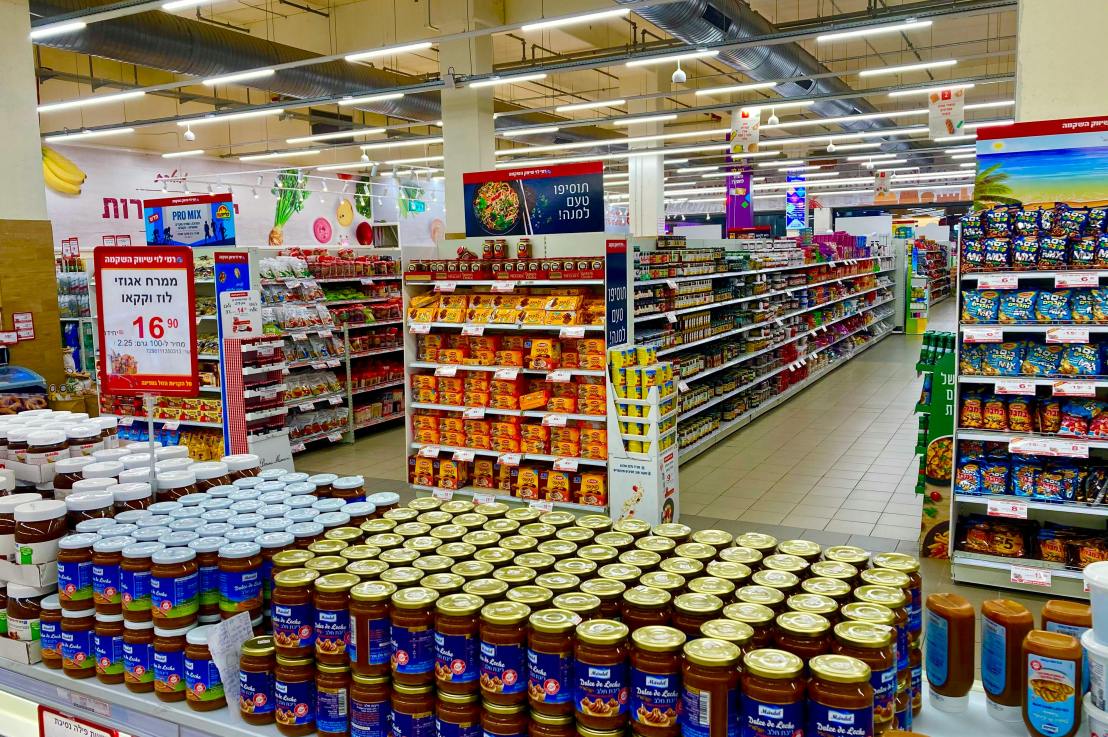
Retail stores rarely feel organised by accident. Customers notice layout problems almost immediately, even if they do not consciously think about them.
Aisles that feel too narrow, inconsistent shelving heights, poor product grouping, crowded promotional bins, or unclear navigation all create friction during the shopping experience. Once that friction appears, customers tend to browse less, move faster through the store, and skip sections entirely.
Well organised stores create the opposite effect.
Shoppers feel comfortable moving through the space. Products are easier to locate. Displays feel intentional rather than random. Customers spend less mental energy trying to understand the environment, which often leads to longer browsing sessions and higher purchase activity.
Organisation also influences trust. Stores that feel structured and easy to shop in are often perceived as more professional, cleaner, and more reliable. That perception matters across almost every retail category, including supermarkets, pharmacies, hardware stores, bottle shops, and convenience stores.
First Impressions Start at the Entrance
The first few metres inside a retail store shape how customers feel about the entire shopping experience.
An organised entrance creates clarity. Customers immediately understand where to walk, where promotions are located, and how the store flows. A cluttered entrance does the opposite and can make the store feel stressful before shoppers even begin browsing.
Some of the most common entrance problems include:
- Overstocked promotional bins near the doorway.
- Shelving positioned too close to entry points
- Poor visibility into the rest of the store.
- Inconsistent signage.
- Narrow walkways that slow customer movement.
Open sightlines usually improve customer comfort. When shoppers can quickly scan categories and navigate naturally, stores tend to feel larger, calmer, and easier to shop in.
Retailers also underestimate how much visual balance matters. Even smaller stores can feel organised when fixtures, displays, and shelving follow a consistent structure.
Clear Store Layouts Reduce Shopper Friction
Store layout affects far more than appearance. It directly influences how customers move, browse, and interact with products.
In practical terms, organised layouts reduce unnecessary decisions. Customers should not have to stop repeatedly to figure out where categories begin, where aisles lead, or how the store is structured.
Retail environments that feel easy to shop in often share similar layout characteristics:
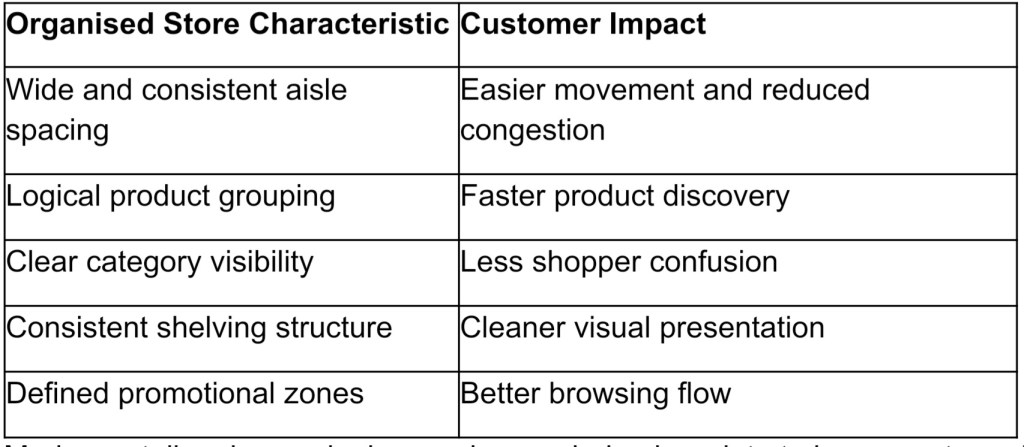
Modern retailers increasingly use shopper behaviour data to improve store planning. Many businesses now rely on insights from broader retail store layout statistics and trends to understand how shelving placement, aisle design, and traffic flow affect customer behaviour inside physical retail environments.
Different layouts also serve different retail goals.
Grid layouts are common in supermarkets and convenience stores because they maximise product exposure and simplify navigation. Free flow layouts are more common in fashion and boutique retail environments where discovery and browsing are prioritised.
Neither approach works well if the store feels overcrowded.
Shelving Plays a Bigger Role Than Most Retailers Realise
Many retailers focus heavily on products, branding, or signage while overlooking the physical shelving structure itself.
Customers notice shelving more than most businesses realise.
Uneven shelf heights, overcrowded displays, inconsistent bay spacing, or poorly aligned fixtures can quickly make a store feel chaotic. Even strong product ranges can appear disorganised when shelving systems are inconsistent.
Several shelving factors heavily influence how organised a retail space feels:
Shelf Height Consistency
Large height variations across aisle runs can create visual clutter. Consistent heights generally create cleaner sightlines and improve overall store readability.
Shelf Depth
Shelves that are too deep often lead to overstacking and hidden products. Shallower displays can sometimes improve visibility and reduce visual congestion depending on the product category.
Product Density
Too many products packed into a single bay can overwhelm shoppers. Empty space is important in retail presentation because it improves product visibility and reduces decision fatigue.
Fixture Alignment
Crooked shelving runs or inconsistent spacing between bays can make stores feel poorly maintained, even when products are fully stocked.
In supermarkets, gondola shelving is commonly used because it creates a structured and repeatable merchandising system. In smaller retail stores, modular shelving systems help businesses adapt layouts more easily as product ranges change.
Good shelving supports customer flow rather than interrupting it.
Product Grouping and Visual Consistency Matter
Poor product grouping forces customers to work harder than necessary.
Shoppers expect products to be organised logically. When related products are scattered across different sections, the store begins to feel confusing regardless of how clean it appears physically.
A well organised retail environment often follows a simple principle, similar products should sit near each other and categories should feel predictable.
Retailers commonly group products using:
- Product function
- Brand
- Usage occasion
- Customer buying intent
- Product size or format
- Price tier
Visual consistency matters just as much as grouping itself.
For example, inconsistent ticketing, mixed signage styles, or random promotional displays can break the visual rhythm of a store. Customers may not consciously identify the issue, but the environment often feels harder to process mentally.
Clean retail presentation usually depends on repetition and structure.
Consistent shelf labelling, aligned pricing displays, standardised signage, and balanced merchandising all contribute to a calmer shopping experience.
Why Poor Stock Management Makes Stores Feel Disorganised
Retail organisation is not only about layout design. Inventory control plays a major role as well.
Stores with inconsistent stock levels often feel harder to shop in because customers encounter visual imbalance throughout the space. One aisle may look overcrowded while another appears half empty.
Both situations create problems.
Overstocked shelves can make products difficult to browse. Customers may struggle to reach items, read labels, or compare products properly. At the same time, heavily packed shelving often creates a cluttered appearance that reduces overall store readability.
On the other side, empty shelving creates uncertainty. Customers may assume products are unavailable, poorly managed, or discontinued.
Some common operational issues that negatively affect store organisation include:
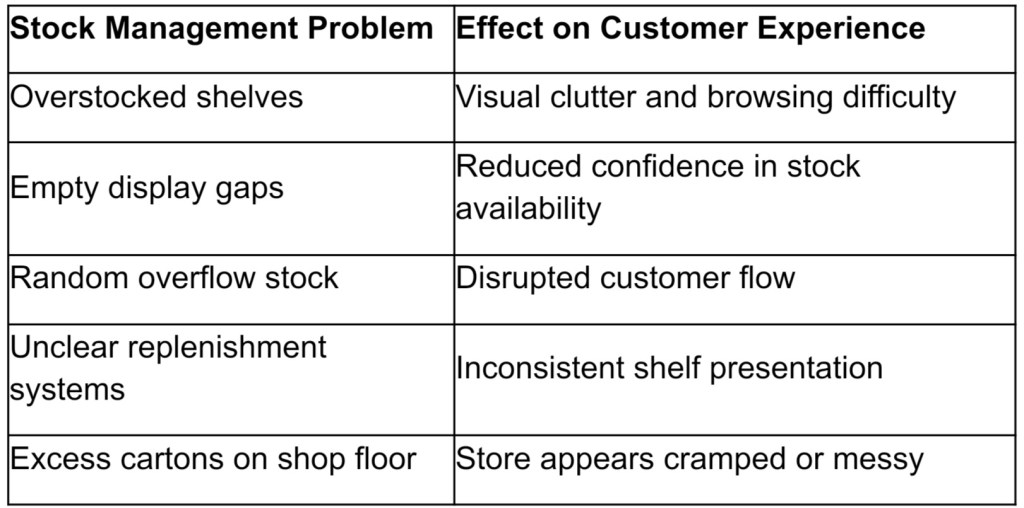
Good retail presentation depends heavily on maintaining balance. Shelves should feel full enough to communicate product availability without appearing overcrowded.
How Lighting and Visibility Affect Store Organisation
Lighting changes how customers interpret space.
Even well planned layouts can feel disorganised if visibility throughout the store is poor. Dark sections, uneven lighting, or shadows across shelving often make stores feel smaller and more difficult to navigate.
Bright retail environments usually improve product visibility and customer comfort simultaneously.
Several lighting factors influence how organised a store feels:
- Consistent lighting across aisles
- Clear visibility of shelving labels
- Reduced glare on packaging
- Highlighted promotional zones
- Strong visibility into rear sections of the store
Visibility also affects customer movement. Shoppers naturally avoid areas that feel hidden, crowded, or visually confusing.
Retailers sometimes focus only on decorative lighting while overlooking functional visibility. In practical retail environments, clarity matters more than dramatic presentation.
A clean combination of shelving structure, lighting consistency, and open sightlines usually creates a far smoother shopping experience.
How Mills Shelving Helps Retail Stores Create More Organised Shopping Environments
Mills Shelving works with Australian retailers to create shelving systems that improve organisation, merchandising flexibility, and overall store usability.
Rather than treating shelving as simple product storage, the company focuses on practical retail environments where layout efficiency, product visibility, and long term durability all matter.
Their shelving systems are commonly used across:
- Supermarkets Convenience stores
- Bottle shops
- Pharmacies
- Pet stores
- Automotive retailers
- General retail stores
Modular gondola shelving plays a major role in helping retailers maintain consistency across aisle runs and merchandising zones. Adjustable shelving also gives stores more flexibility as product ranges evolve over time.
For growing retailers, scalability becomes important as well.
Consistent shelving systems make it easier to expand stores, adjust layouts, introduce promotional zones, and improve product presentation without completely redesigning the retail floor.
Organisation is easier to maintain when the shelving system itself is designed for flexibility and long term retail use.
Signs a Retail Store Layout Needs Improvement
Some retail layout problems become obvious immediately. Others develop gradually over time as stock levels, product ranges, and merchandising strategies change.
Retailers should usually review store organisation if they notice recurring issues such as:
Customers Frequently Asking for Product Locations
When shoppers regularly struggle to locate products, navigation problems often exist within the layout structure.
Congested High Traffic Areas
Bottlenecks near entrances, checkout zones, or promotional displays usually indicate poor aisle spacing or fixture positioning.
Inconsistent Merchandising Between Sections
Different shelving styles, uneven presentation standards, or random promotional placement can make the store feel fragmented.
Poor Visibility Across the Store
Limited sightlines often reduce customer movement into certain areas of the retail floor.
Overflow Stock Appearing Around Walkways
Temporary stock storage near aisles or display ends quickly creates visual clutter and interrupts customer flow.
Retail environments need periodic adjustments. Layouts that worked well several years ago may no longer suit changing customer behaviour or product ranges.
Final Thoughts
Retail stores feel organised when customers can move comfortably, locate products quickly, and browse without unnecessary friction. Layout structure, shelving consistency, lighting, stock management, and merchandising all contribute to that experience.
Small operational and layout improvements often make a larger impact than retailers expect. At Mills Shelving, we help Australian retailers build practical shelving environments that improve organisation, customer flow, and long term store flexibility across a wide range of retail industries.


You must be logged in to post a comment.