Most eCommerce SEO strategies look busy on the surface. Product pages are optimised, keywords are inserted, and new items are constantly added. Yet revenue barely moves.
The problem is not effort, it is direction.
Many stores treat SEO as a page-level activity. Optimise a product, publish it, wait for rankings. That approach ignores how search actually works. Customers do not land neatly on a single product and convert instantly. They browse, compare, hesitate, and return.
Real eCommerce SEO is not about individual pages. It is about building a structure that captures intent at every stage and guides users towards a purchase.
The Foundation: How Customers Actually Search and Buy
Buying behaviour rarely follows a straight line. A typical journey moves through multiple stages.
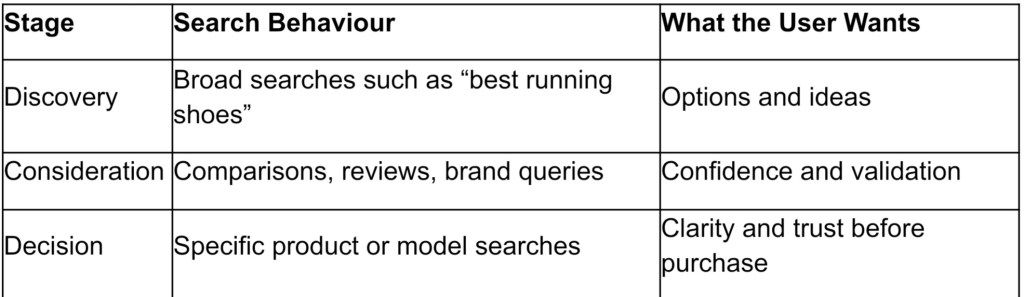
A store that only targets the final stage limits its growth. Product pages sit at the bottom of the funnel. They capture demand that already exists, but they do not create it.
Growth comes from covering the full journey. That means category pages, supporting content, and internal pathways that move users forward rather than leaving them to navigate alone.
Where Most Stores Go Wrong
There is a pattern across underperforming eCommerce sites. The same issues appear again and again:
- Product pages are over-optimised for keywords but lack depth or trust signals
- Category pages are thin, often just grids with little context or guidance
- Internal links are inconsistent or missing entirely
- Content exists in isolation, with no clear connection to revenue-driving pages.
In many cases, effort is being applied, but not in the right areas. The result is traffic that does not convert, or worse, no traffic at all.
The Role of Category Pages in SEO and Revenue
Category pages are often overlooked, yet they are one of the strongest drivers of both traffic and revenue.
They sit at a critical point in the journey. Broad enough to capture high-volume searches, specific enough to guide decision-making.
A well-built category page does more than list products. It helps users choose.
Effective category pages typically include:
- Clear, intent-driven headings aligned with search queries
- Short, useful copy that explains options and differences
- Logical filtering that reduces friction
- Internal links that guide users deeper into relevant products
From an SEO perspective, category pages also carry more authority. They attract links, rank for broader terms, and pass value down to product pages.
From a conversion perspective, they reduce overwhelm. Instead of forcing users to evaluate dozens of products blindly, they provide structure.
Product Pages: Designed for Conversion, Not Just Rankings
Product pages are where revenue happens, but they are often treated as the primary SEO target. That is where many strategies fall short.
A product page has a different role. It should convert intent, not generate it.
Rather than chasing rankings, strong product pages focus on clarity and trust:
- Detailed product descriptions that answer real questions
- High-quality images that remove uncertainty
- Reviews or proof points that reinforce credibility
- Clear pricing and delivery information
- FAQs that handle objections before they arise
Trying to rank every product page for competitive keywords spreads effort too thin. In most cases, it is more effective to let category pages capture traffic and guide users towards products that are built to convert.
When done properly, product pages become the final step in a system, not the starting point.
Connecting the System: Internal Linking and Site Architecture
An eCommerce site should not feel like a collection of pages. It should function as a connected system.
The structure behind that system determines how both users and search engines move through the site. When it is done properly, every page has a purpose and supports another.
Think of it in layers:
- Category pages capture broad demand
- Product pages convert that demand
- Supporting content feeds both
What ties them together is internal linking.
A strong internal linking structure:
- Guides users towards relevant products without friction
- Distributes authority from high-performing pages to weaker ones
- Reinforces topical relevance across categories
- Helps search engines understand relationships between pages
Without this structure, even well-optimised pages struggle. They exist, but they do not support each other.
Supporting Content: The Missing Layer in Most SEO Strategies
Many stores either ignore content entirely or treat it as an afterthought. When used properly, it becomes a key driver of growth.
Supporting content sits in the middle of the funnel. It captures users who are not ready to buy yet, but are actively researching.
Examples include:
- Buying guides that explain key considerations
- Comparison articles that help narrow choices
- “Best of” lists that surface popular options
- Use-case content that connects products to real scenarios.
The role of this content is simple. Bring users in, build trust, and direct them towards categories and products.
It should not exist in isolation. Each piece needs clear pathways:
- Links into relevant category pages
- Contextual mentions of suitable products
- Logical next steps for the reader
When connected properly, content becomes a consistent source of qualified traffic that supports revenue, not just visibility.
What Real eCommerce SEO Looks Like in Practice
At a glance, effective eCommerce SEO can look simple. In reality, it is structured and deliberate.A practical approach tends to follow a pattern:
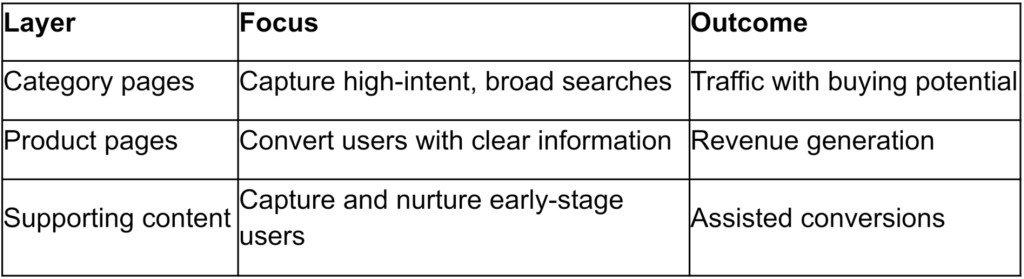
The difference lies in execution. Each layer is built with intent, not just keywords.
For many businesses, implementing this properly requires a shift in thinking. It is less about publishing more pages and more about building the right structure.
Working with specialists who provide eCommerce SEO Services can accelerate this process, especially when the focus is on aligning site architecture, content, and conversion rather than isolated tactics.
Marketix Digital: A Revenue-First Approach to eCommerce SEO
Marketix Digital represents a more modern approach to eCommerce SEO, one that prioritises outcomes over activity.
Instead of chasing rankings alone, the focus is placed on how SEO contributes to revenue.
Key differences in approach include:
- Targeting commercial intent keywords that lead to sales, not just traffic
- Structuring category and product pages to guide decision-making
- Integrating SEO with conversion optimisation to improve performance
- Building internal linking systems that support long-term growth
The result is a strategy that connects visibility with conversion, rather than treating them as separate goals.
Measuring Success: Beyond Rankings and Traffic
Traditional SEO reporting often highlights rankings and traffic growth. While useful, they only tell part of the story.
For eCommerce, the real indicators sit closer to revenue:
- Organic revenue, how much income comes directly from search
- Conversion rate, how effectively traffic turns into buyers
- Average order value, the quality of each transaction
- Assisted conversions, the role SEO plays across the full journey
A page that ranks well but fails to convert offers limited value. On the other hand, a page that brings in fewer visitors but drives consistent sales is far more impactful.
Focusing on the right metrics shifts decision-making. It moves SEO from a visibility exercise to a growth channel.
SEO as a System, Not a Set of Pages
eCommerce SEO works when every part of the site supports the others.
Category pages capture demand. Product pages convert it. Content expands reach and builds trust. Internal linking connects everything.
Treating these elements separately leads to inconsistent results. Treating them as a system creates momentum.
Businesses that adopt this approach tend to see a different outcome. Traffic becomes more qualified, conversions improve, and SEO starts contributing directly to revenue.
The shift is not about doing more. It is about building the right structure and letting it work as a whole.


You must be logged in to post a comment.