Tag: llm

The AI Model Glow-Up: What AI Professionals Must Learn Next

The AI Model Glow-Up: What AI Professionals Must Learn Next

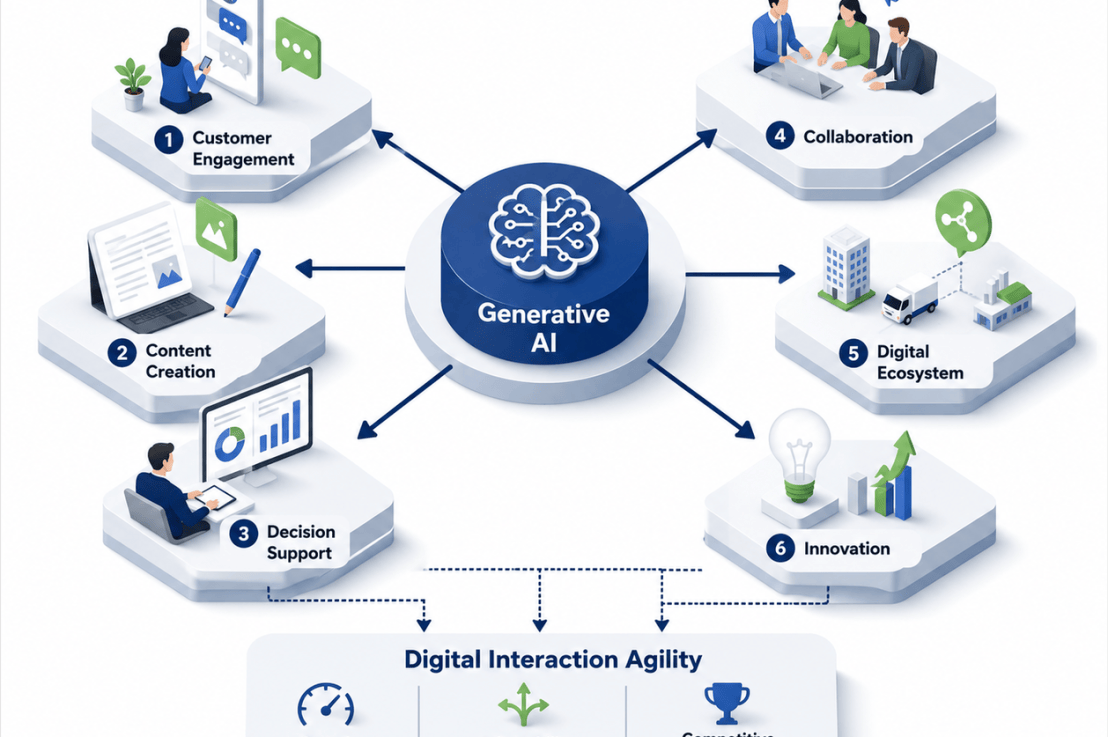
Remember when knowing “prompt engineering” was enough to look like the smartest person in the meeting? That skill now has the shelf life of a mango in a Delhi June. In just three years, AI models have gone from witty chatbots that wrote poems about your cat to software agents that read your codebase, call APIs, and file the ticket before you finish your chai.

Continue reading “The AI Model Glow-Up: What AI Professionals Must Learn Next” →
Small Language Models: Big Brains in Small Packages

Small Language Models: Big Brains in Small Packages

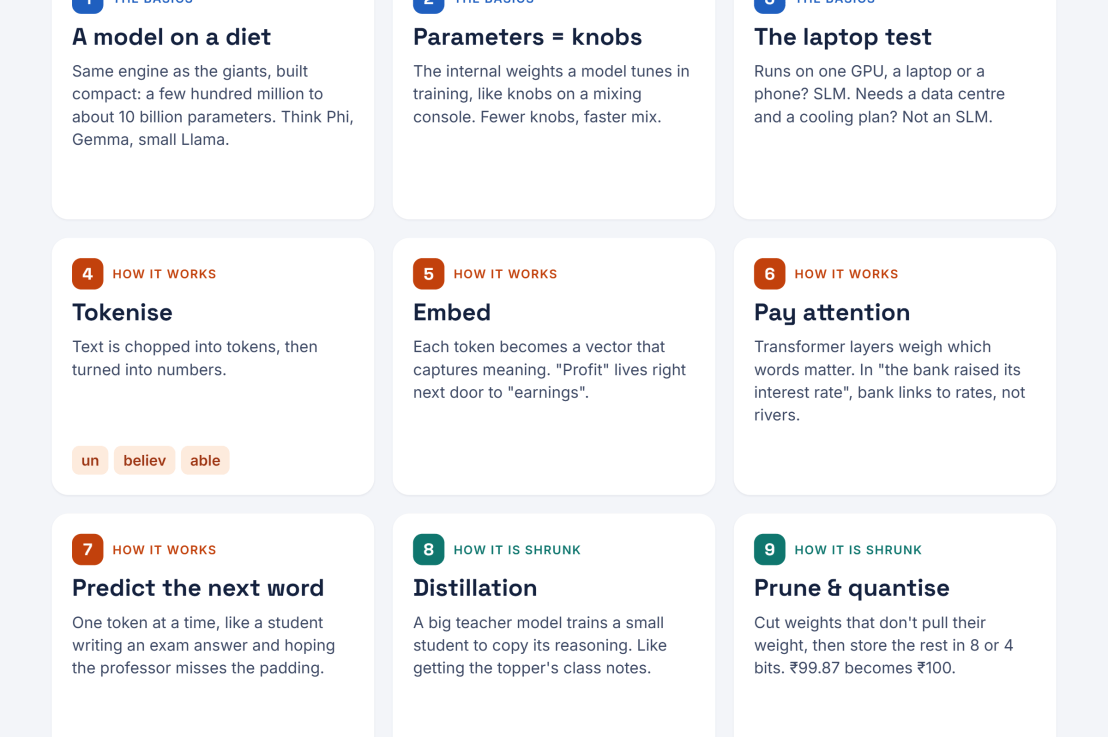
For the last few years, the AI industry has behaved like a teenager at a gym: bigger, bigger, bigger. Every new language model arrived with more parameters, more data and a bigger electricity bill than the last. Then a quiet rebellion began. Researchers started asking a very Indian question: “Kitna deti hai?” How much performance do we actually get for every rupee of compute? The answer gave rise to Small Language Models, or SLMs. These are the compact, fuel-efficient cousins of giant models like GPT or Claude. They will not win a trivia contest against their big relatives, but they can run on your laptop, answer in a blink, and keep your data at home. In this post, let us open the bonnet and see what SLMs are, how they work, and why businesses are suddenly so fond of them.

Continue reading “Small Language Models: Big Brains in Small Packages” →
SLMs vs RAG: Small Brains, Big Libraries

SLMs vs RAG: Small Brains, Big Libraries

The Great GenAI Mix-up

In every boardroom discussion on generative AI these days, two acronyms get thrown around like confetti at a Delhi wedding: SLMs and RAG. Someone says, “We should go for an SLM,” someone else says, “No, RAG is better,” and everyone nods wisely while quietly Googling both under the table. Here is the twist. Comparing Small Language Models (SLMs) with Retrieval-Augmented Generation (RAG) is a bit like comparing a compact car with Google Maps. One is the vehicle; the other is a way of finding where to go. They solve different problems, and understanding that difference is exactly what helps managers make smarter AI investments.

Continue reading “SLMs vs RAG: Small Brains, Big Libraries” →
Beyond ChatGPT: Understanding the Models Powering the Generative AI Revolution

Beyond ChatGPT: Understanding the Models Powering the Generative AI Revolution

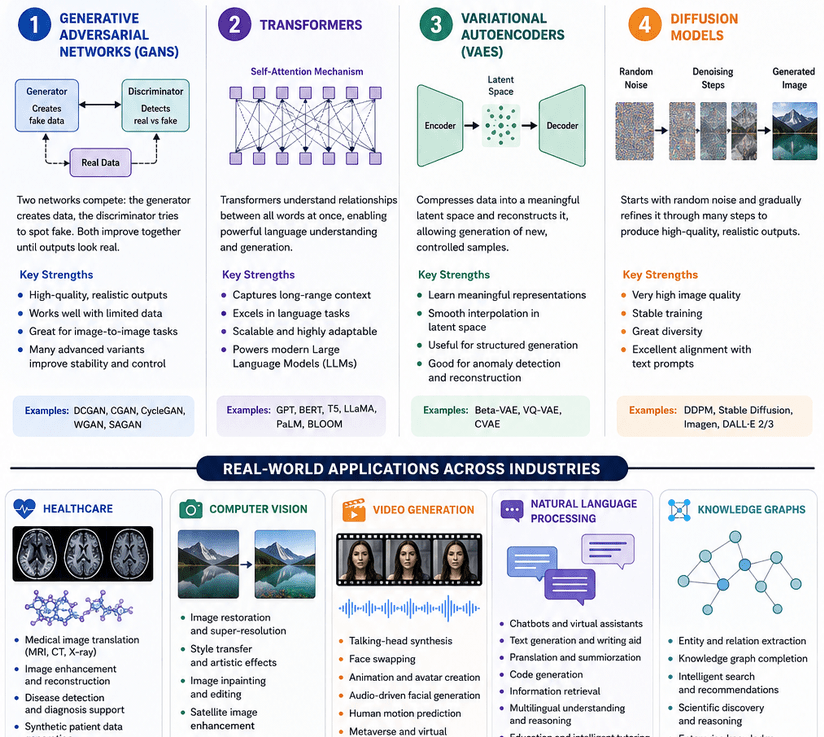
The remarkable success of Generative AI is not driven by a single algorithm but by the evolution of several complementary model architectures, each designed to solve specific computational challenges. Early deep learning systems often struggled with unstable training, poor-quality outputs, limited diversity, and high computational costs. Over the past decade, researchers have progressively addressed these limitations by developing increasingly sophisticated generative models. Today, four dominant architectures—Generative Adversarial Networks (GANs), Transformers, Variational Autoencoders (VAEs), and Diffusion Models—form the technological backbone of modern Generative AI. Each architecture approaches content generation differently and has distinct strengths that make it suitable for particular applications ranging from computer vision and language processing to scientific research and healthcare.

Continue reading “Beyond ChatGPT: Understanding the Models Powering the Generative AI Revolution” →

What is Prompt Engineering: An overview

Prompt engineering refers to the practice of designing and structuring inputs to large language models so that they produce accurate, useful, and reliable outputs. As language models have grown more capable, the way prompts are written has become an important skill, blending aspects of linguistics, logic, and problem formulation. Over time, several distinct types of prompt engineering have emerged, each suited to different tasks and levels of model guidance. The following discussion presents the main types of prompt engineering in an essay-style narrative, with an example woven into each explanation.

Continue reading “What is Prompt Engineering: An overview” →