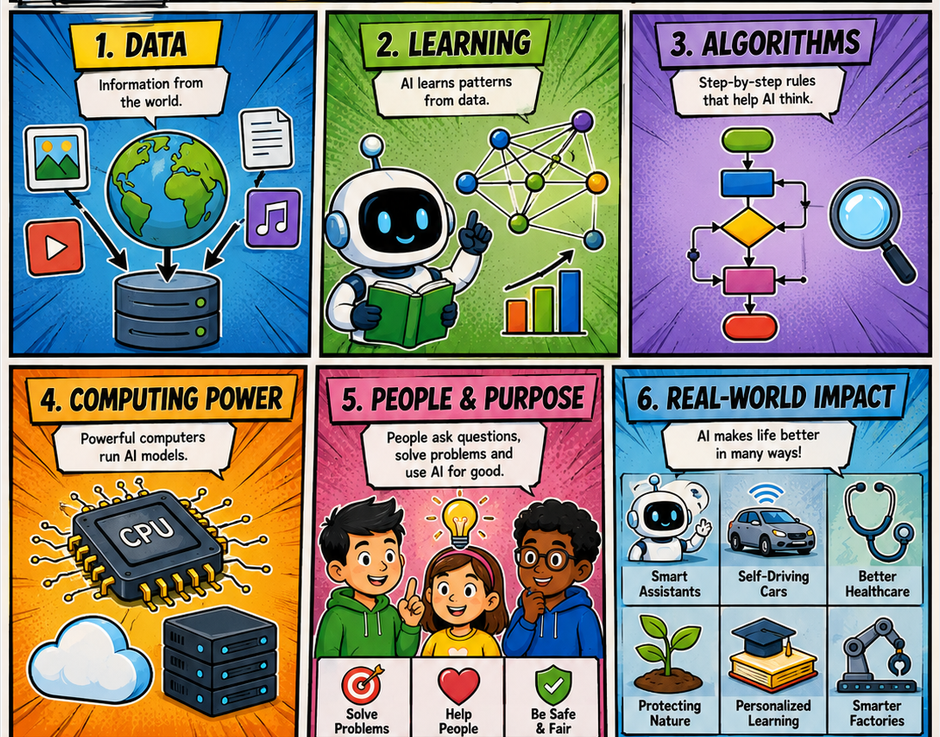
Remember when knowing “prompt engineering” was enough to look like the smartest person in the meeting? That skill now has the shelf life of a mango in a Delhi June. In just three years, AI models have gone from witty chatbots that wrote poems about your cat to software agents that read your codebase, call APIs, and file the ticket before you finish your chai.
Continue reading “The AI Model Glow-Up: What AI Professionals Must Learn Next”Tag: chatgpt
Small Language Models: Big Brains in Small Packages
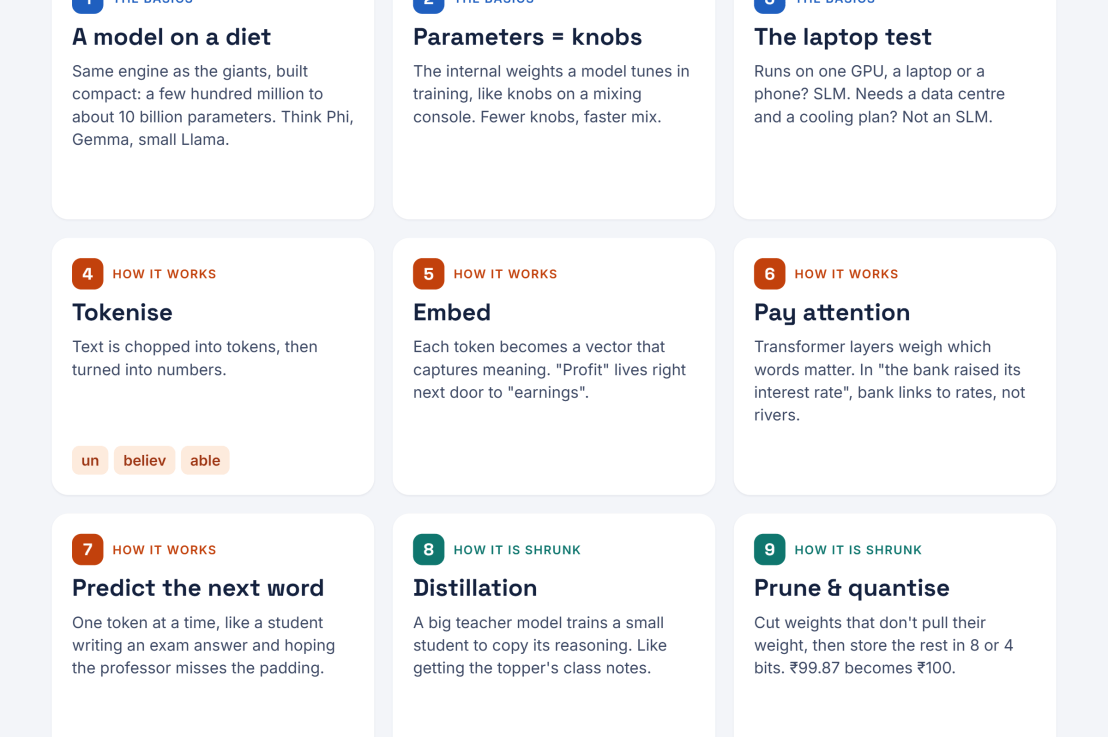
For the last few years, the AI industry has behaved like a teenager at a gym: bigger, bigger, bigger. Every new language model arrived with more parameters, more data and a bigger electricity bill than the last. Then a quiet rebellion began. Researchers started asking a very Indian question: “Kitna deti hai?” How much performance do we actually get for every rupee of compute? The answer gave rise to Small Language Models, or SLMs. These are the compact, fuel-efficient cousins of giant models like GPT or Claude. They will not win a trivia contest against their big relatives, but they can run on your laptop, answer in a blink, and keep your data at home. In this post, let us open the bonnet and see what SLMs are, how they work, and why businesses are suddenly so fond of them.
Continue reading “Small Language Models: Big Brains in Small Packages”My Chatbot Has a Best Friend – Ways AI Tries to Feel Human
Imagine you open an app and an animated character you have been chatting with sends you a message: “So, my friend XXX was playing dodgeball in P.E. class, and while trying to dodge the ball, he tripped and fell. Oh gosh.” You chuckle. Poor XXX. You type back, “Is he okay?” and before you know it, you have exchanged twenty messages about a gym class that never happened, involving a boy who does not exist, told by a character who is entirely made of code.
Continue reading “My Chatbot Has a Best Friend – Ways AI Tries to Feel Human”Beyond ChatGPT: Understanding the Models Powering the Generative AI Revolution
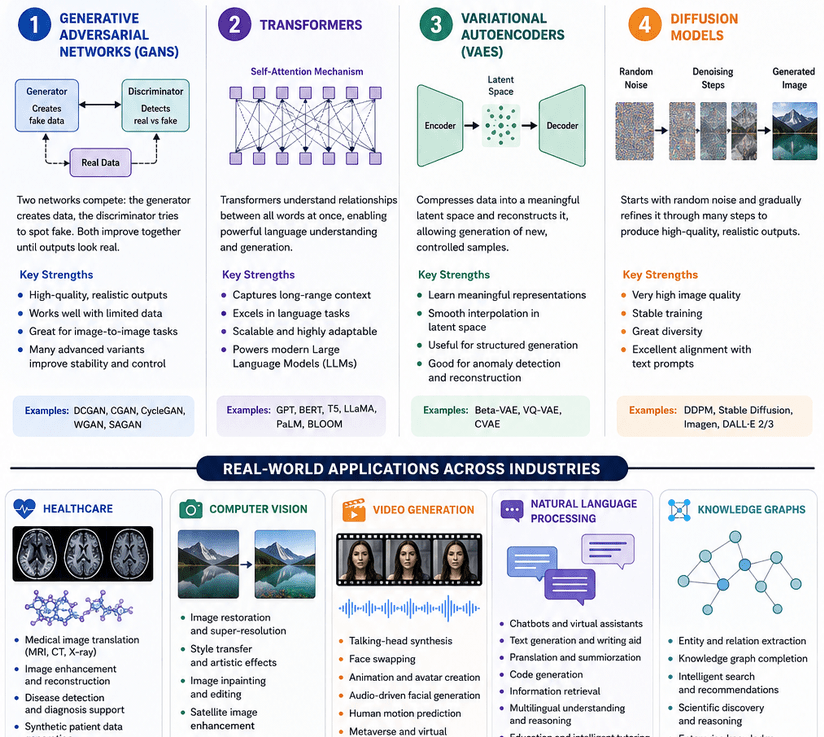
The remarkable success of Generative AI is not driven by a single algorithm but by the evolution of several complementary model architectures, each designed to solve specific computational challenges. Early deep learning systems often struggled with unstable training, poor-quality outputs, limited diversity, and high computational costs. Over the past decade, researchers have progressively addressed these limitations by developing increasingly sophisticated generative models. Today, four dominant architectures—Generative Adversarial Networks (GANs), Transformers, Variational Autoencoders (VAEs), and Diffusion Models—form the technological backbone of modern Generative AI. Each architecture approaches content generation differently and has distinct strengths that make it suitable for particular applications ranging from computer vision and language processing to scientific research and healthcare.
Continue reading “Beyond ChatGPT: Understanding the Models Powering the Generative AI Revolution”Which IT roles will AI automate most
Specific IT roles are likely to be replaced with the advent of generative artificial intelligence. We wanted to undertake a brief survey of which roles are likely to be more impacted and hence, professionals in these roles should look into reskilling their portfolio and competency. Reskilling in AI/ML use could be a way to strengthen competency within this area itself.
Continue reading “Which IT roles will AI automate most”What is Prompt Engineering: An overview
Prompt engineering refers to the practice of designing and structuring inputs to large language models so that they produce accurate, useful, and reliable outputs. As language models have grown more capable, the way prompts are written has become an important skill, blending aspects of linguistics, logic, and problem formulation. Over time, several distinct types of prompt engineering have emerged, each suited to different tasks and levels of model guidance. The following discussion presents the main types of prompt engineering in an essay-style narrative, with an example woven into each explanation.
Continue reading “What is Prompt Engineering: An overview”Case Study – Use of Agentic AI in Search Engine Marketing
Breaking News! Google Specialist releases guide to Agentic AI systems
Antonio Gulli’s comprehensive book covers 21 design patterns for building autonomous AI agents, featuring practical frameworks and technical implementation guides for developers. Antonio Gulli, a Google distinguished engineer, has published a comprehensive 400-page technical guide to building autonomous AI systems, offering detailed blueprints for creating sophisticated artificial intelligence agents. Antonio Gulli, Senior Director and Distinguished Engineer in Google’s CTO Office, announced Agentic Design Patterns: A Hands-On Guide to Building Intelligent Systems with a scheduled release date of December 3, 2025. The publication addresses a critical gap in AI development methodology. According to Gulli, building effective agentic systems requires more than just a powerful language model—it demands structured architectural blueprints. “It’s about moving from raw capability to robust, real-world applications,” Gulli stated in the book’s introduction. The guide presents 21 distinct agentic patterns that serve as fundamental building blocks for autonomous AI systems. These patterns range from foundational concepts such as Prompt Chaining and Tool Use to advanced implementations including Multi-Agent Collaboration and Self-Correction frameworks. Each pattern represents a reusable solution to common challenges encountered when building intelligent, goal-oriented systems
Continue reading “Case Study – Use of Agentic AI in Search Engine Marketing”Demystifying Artificial Intelligence using Set Theory
The Evolution of Artificial Intelligence: From Logic to Learning
Artificial Intelligence (AI) has evolved from a theoretical curiosity into a transformative force reshaping industries, societies, and human potential. Its journey spans decades of innovation, marked by paradigm shifts—from symbolic reasoning to statistical learning, and now to generative intelligence. Understanding this evolution reveals not just technological progress, but a deeper narrative about how machines have come to mimic, augment, and even challenge human cognition.
Continue reading “Demystifying Artificial Intelligence using Set Theory”


You must be logged in to post a comment.