Category: Emerging Technologies

Beyond ChatGPT: Understanding the Models Powering the Generative AI Revolution

Beyond ChatGPT: Understanding the Models Powering the Generative AI Revolution

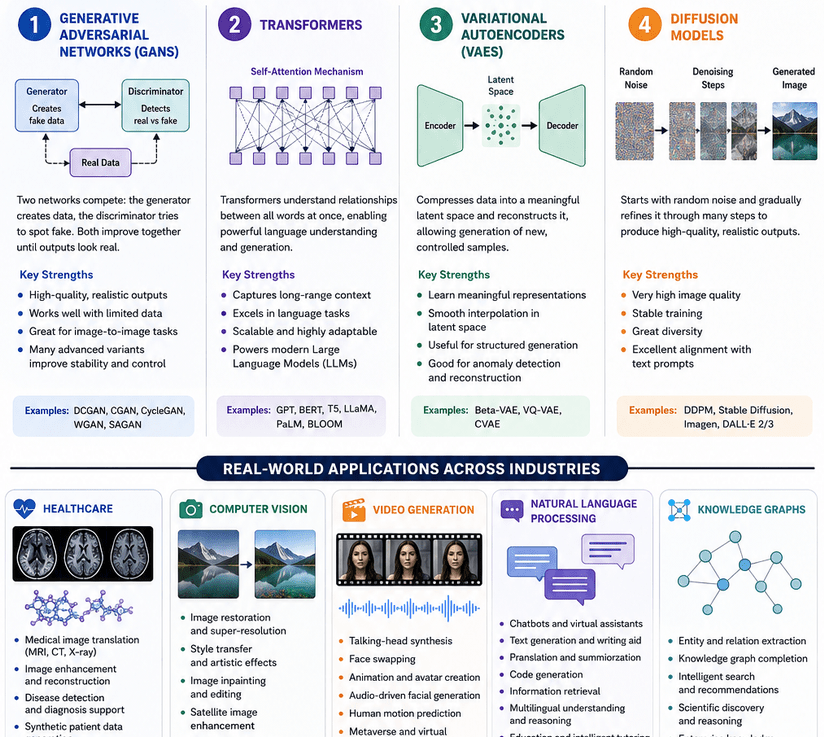
The remarkable success of Generative AI is not driven by a single algorithm but by the evolution of several complementary model architectures, each designed to solve specific computational challenges. Early deep learning systems often struggled with unstable training, poor-quality outputs, limited diversity, and high computational costs. Over the past decade, researchers have progressively addressed these limitations by developing increasingly sophisticated generative models. Today, four dominant architectures—Generative Adversarial Networks (GANs), Transformers, Variational Autoencoders (VAEs), and Diffusion Models—form the technological backbone of modern Generative AI. Each architecture approaches content generation differently and has distinct strengths that make it suitable for particular applications ranging from computer vision and language processing to scientific research and healthcare.

Continue reading “Beyond ChatGPT: Understanding the Models Powering the Generative AI Revolution”
Top Cloud-Based Test Automation Tools to Watch in 2026

Top Cloud-Based Test Automation Tools to Watch in 2026

The world is now witnessing the wonders of automation, and the software industry is right in the middle of it. If you are still doing manual testing, you are lagging behind your competitors. As AI Multiple Research reveals, about 33% of companies are planning to automate between 50% to 75% of the testing process, and almost 20% of the companies are planning to automate over 75%.

Continue reading “Top Cloud-Based Test Automation Tools to Watch in 2026”
Case Study: LUXE & CO.: CALIBRATING AI PERSONALIZATION IN PREMIUM RETAIL

Case Study: LUXE & CO.: CALIBRATING AI PERSONALIZATION IN PREMIUM RETAIL

This fictitious case study examines the strategic dilemma faced by Luxe & Co., a premium fashion and lifestyle brand navigating the transition from a relationship-driven physical retail model to a data-intensive digital environment. By 2025, the company had successfully shifted a majority of its revenue to e-commerce; however, this transition exposed deeper structural challenges. Rising customer acquisition costs, stagnant customer lifetime value, and declining repeat purchase rates signaled a weakening connection between the brand and its customers. Recognizing that the issue lay not in product quality but in the erosion of personalized engagement, Chief Marketing Officer Sarah Chen initiated a €15 million pilot program to test an artificial intelligence–driven personalization platform, StyleAI.

Continue reading “Case Study: LUXE & CO.: CALIBRATING AI PERSONALIZATION IN PREMIUM RETAIL”