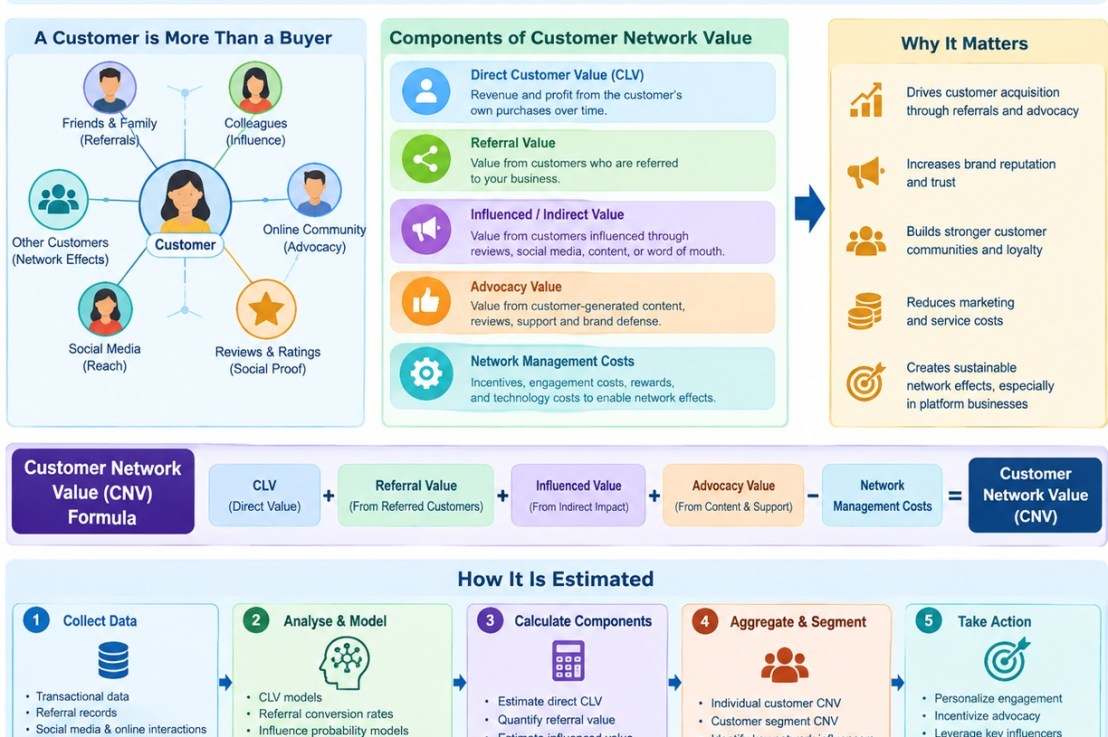
Traditional customer relationship management has generally evaluated customers according to the economic value of their own transactions. Measures such as sales revenue, customer lifetime value (CLV), retention rate, and purchase frequency help organizations identify customers who generate greater direct financial returns. However, in digitally connected markets, a customer can create value that extends far beyond his or her own purchases. Customers influence friends, colleagues, online communities, social-media audiences, and other potential customers. They may provide referrals, generate reviews, create content, strengthen brand reputation, and facilitate access to other customers. The economic value generated through these relationships can be conceptualized as customer network value (CNV).
Customer network value therefore extends the traditional customer-centric perspective toward a network-centric perspective of customer value. Instead of asking only, “How much profit will this customer generate through direct purchases?”, an organization asks, “How much economic value can this customer generate through the broader network of relationships that he or she influences?” This distinction is particularly important for platform businesses, social commerce, professional services, financial services, telecommunications, and digitally mediated businesses in which customer interactions can substantially affect the behavior of other customers.
At its simplest, customer network value can be conceptualized as the additional value generated by a customer through his or her network, after accounting for the customer’s own direct economic contribution. A useful conceptual representation is:
Customer Network Value = Direct Customer Value + Network-Generated Value − Network Management Costs
Direct customer value is generally captured through measures such as customer lifetime value. Network-generated value includes referrals, influenced purchases, advocacy, social engagement, reviews, content creation, and other measurable effects on the behavior of other customers. Network management costs include referral incentives, customer engagement costs, rewards, promotional expenditure, and the technological costs associated with facilitating network interactions.
The first component in estimating customer network value is therefore the customer’s own lifetime value. CLV estimates the expected future contribution of a customer over the duration of the relationship. A simplified formulation is:
CLV = Σ [(Revenueₜ − Costₜ) × Retention Probabilityₜ] / (1 + Discount Rate)ᵗ
where t represents a future period. More sophisticated models incorporate customer-specific purchase frequency, margins, retention probabilities, discount rates, and acquisition or service costs. CLV provides the baseline against which incremental network effects can be evaluated.
The second component is referral value. Some customers actively introduce other individuals to a company. A customer who recommends a product to five friends who subsequently become paying customers has created economic value beyond his or her own purchases. Estimating referral value requires identifying the number of referrals generated, the probability that a referral converts, the expected CLV of the referred customer, and the cost of acquiring and servicing the referral.
For example, suppose a customer generates ten qualified referrals during a year. If each referral has a 20 percent probability of becoming a customer and the average incremental CLV of an acquired customer is ₹20,000, the expected referral value before referral costs would be:
10 × 0.20 × ₹20,000 = ₹40,000
If the organization spends ₹5,000 on referral incentives and associated costs, the estimated net referral value becomes ₹35,000. This value can then be combined with the focal customer’s own CLV.
However, referral value represents only one form of network value. Customers can also influence others without explicitly making referrals. This is known as influenced or indirect customer value. A customer might post a product review, recommend a restaurant on social media, answer questions in an online community, or demonstrate a product to colleagues. These activities can influence purchasing decisions even when the organization cannot observe a formal referral.
Estimating such value requires organizations to connect customer interactions with subsequent behavioral outcomes. For instance, a firm could examine whether customers who interact with a particular customer’s social-media content subsequently visit the website, request product information, or purchase the product. Statistical models can then estimate the incremental probability of conversion associated with the customer’s influence.
This introduces an important methodological distinction between correlation and causation. A customer with a large social-media following may be associated with many purchases, but those purchases cannot automatically be attributed to that customer. Consumers may have encountered the product through several other channels. Consequently, advanced customer network valuation requires attribution techniques that attempt to estimate the incremental effect of a customer’s influence.
Another important component is social or advocacy value. Some customers create positive externalities for the organization by writing reviews, producing user-generated content, answering questions, participating in communities, or defending the brand during public discussions. Their contribution can reduce marketing and customer-service costs. For example, an experienced customer who regularly answers questions in an online community may reduce the number of support requests handled by employees.
The economic value of such activity can be estimated by assigning a monetary value to the organizational resources saved. If customer-generated support interactions resolve 1,000 queries that would otherwise have required paid service-agent time, the organization can estimate the corresponding cost savings. Similar approaches can be used to value customer-generated content, reviews, tutorials, and product recommendations.
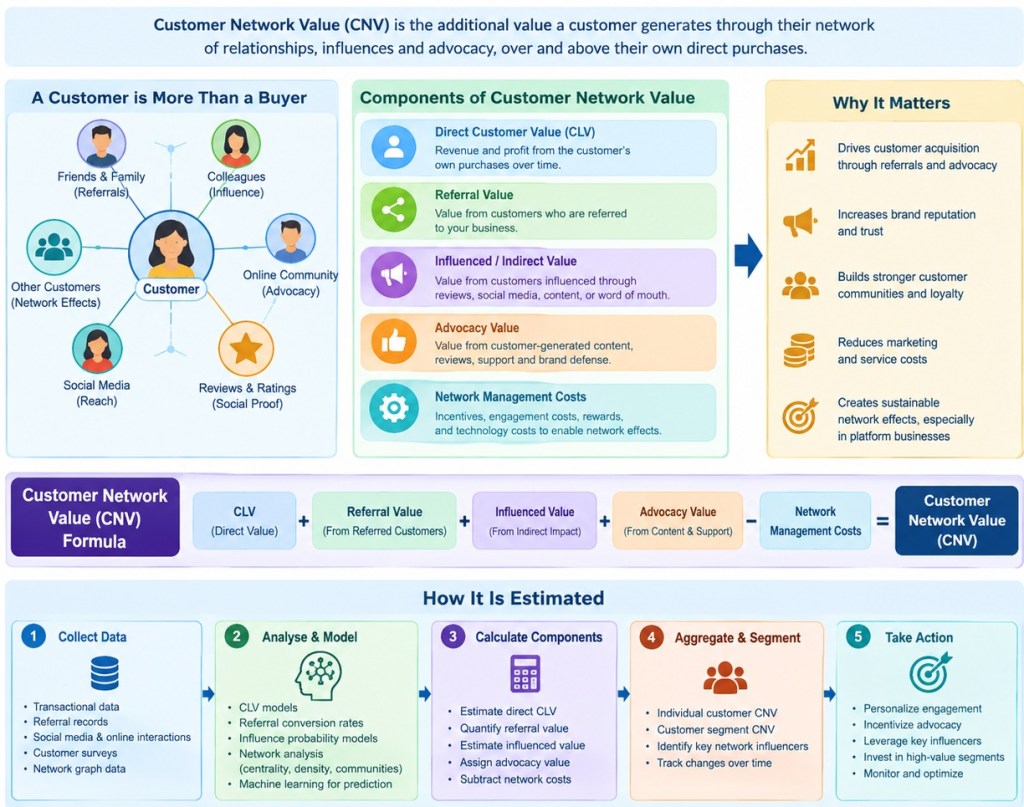
Customer network value becomes particularly significant in platform businesses. In a social network, marketplace, payment platform, ride-sharing service, or professional network, the value of one customer can depend partly on the number and quality of other participants connected to that customer. This creates network externalities. A new customer may increase the attractiveness of the platform for existing customers, while existing customers may increase the value of the platform for the new customer.
In such environments, network value can be estimated using network-analysis techniques. Organizations can construct customer graphs in which customers represent nodes and relationships represent interactions, transactions, referrals, communications, or social connections. Measures such as degree centrality, betweenness centrality, eigenvector centrality, and network density can help identify customers occupying structurally important positions.
For example, a customer with high degree centrality may be directly connected to many other customers. A customer with high betweenness centrality may connect otherwise separate customer communities. Such a customer may have substantial potential to diffuse information across the network. However, network position should not automatically be interpreted as monetary value. Network measures need to be connected with observed economic outcomes such as referrals, conversions, retention, revenue, or cost reduction.
Modern CRM systems increasingly make such estimation possible because they integrate transactional, behavioral, social, and interaction data. Machine-learning models can estimate the probability that a customer will generate referrals, influence purchases, churn, or engage in advocacy. Organizations can then calculate an expected network value for individual customers and customer segments.
A useful extended formulation is:
CNVᵢ = CLVᵢ + Σⱼ [P(i influences j) × Incremental CLVⱼ] + Advocacy Valueᵢ − Network Costᵢ
Here, i represents the focal customer and j represents other potential customers. The key term is the probability that customer i influences customer j. This probability can be estimated using referral histories, interaction networks, social-media engagement, customer journeys, experimental data, or predictive models.
Organizations should also recognize that network value is dynamic. A customer’s network position, influence, purchasing behavior, and engagement can change over time. Consequently, CNV should ideally be estimated periodically rather than treated as a permanent customer characteristic.
Ultimately, customer network value represents an important evolution in CRM thinking. Traditional CRM treats the customer primarily as an individual economic entity; network-oriented CRM recognizes that customers are also nodes within broader systems of influence and value creation. Estimating CNV requires combining CLV with referral behavior, social influence, advocacy, network position, and measurable indirect effects. The emergence of AI, graph analytics, customer data platforms, and real-time CRM makes this increasingly feasible. Organizations that successfully estimate customer network value can therefore move beyond simply identifying their most profitable customers toward understanding which customers contribute to the growth, resilience, and connectivity of the entire customer ecosystem.


You must be logged in to post a comment.