Prompt engineering refers to the practice of designing and structuring inputs to large language models so that they produce accurate, useful, and reliable outputs. As language models have grown more capable, the way prompts are written has become an important skill, blending aspects of linguistics, logic, and problem formulation. Over time, several distinct types of prompt engineering have emerged, each suited to different tasks and levels of model guidance. The following discussion presents the main types of prompt engineering in an essay-style narrative, with an example woven into each explanation.
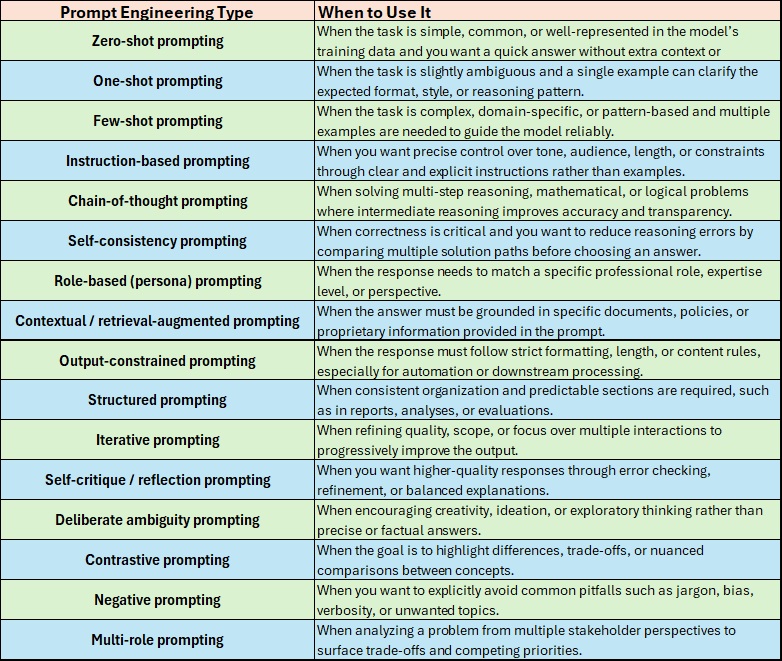
One of the most basic forms of prompt engineering is zero-shot prompting. In zero-shot prompting, the model is given only a task description without any examples or additional guidance. This approach relies entirely on the model’s pretrained knowledge and generalization ability. Zero-shot prompts are useful when tasks are simple, well-defined, or widely represented in the model’s training data. For instance, a prompt such as, “Translate the following sentence from English to French: ‘The bank approved the loan,’” is a zero-shot prompt because the model is not shown any examples of translations beforehand. The effectiveness of zero-shot prompting demonstrates how modern language models can perform a wide range of tasks without explicit instruction beyond a short description.
A step beyond this is one-shot prompting, where the prompt includes a single example to clarify the desired behavior. This technique is helpful when the task may be ambiguous or when subtle formatting or reasoning patterns need to be conveyed. By seeing one example, the model can infer the expected structure or style. For example, a one-shot prompt for sentiment classification might read: “Text: ‘The service was slow and disappointing.’ Sentiment: Negative. Now classify the sentiment of the following text: ‘The app is fast and very easy to use.’” The single example anchors the model’s understanding of what constitutes “sentiment” in this context.
Closely related is few-shot prompting, which provides multiple examples within the prompt. Few-shot prompting is particularly powerful for complex or specialized tasks where patterns are not obvious from a single instance. By observing several input–output pairs, the model learns the underlying rule more robustly. For example, a few-shot prompt for extracting entities might include three short examples of sentences along with labeled entities, followed by a new sentence to analyze. This method often leads to significant improvements in accuracy, especially when the task involves domain-specific conventions or structured outputs.
Another important category is instruction-based prompting, which emphasizes clear, explicit instructions rather than examples. Here, the model is guided by a well-defined directive that specifies not just what to do, but sometimes how to do it or what constraints to follow. For example, an instruction-based prompt could be: “You are a financial analyst. Explain the concept of inflation to a non-technical audience in no more than 150 words, using a simple analogy.” The explicit role assignment, audience specification, and length constraint help shape the model’s response in a predictable way.
A more advanced and widely discussed approach is chain-of-thought prompting. This type encourages the model to reason step by step rather than jumping directly to an answer. By explicitly asking for intermediate reasoning, the prompt helps the model structure its thinking, which is especially useful for mathematical, logical, or multi-step problems. An example would be: “A company’s revenue increased by 20% in the first year and decreased by 10% in the second year. Explain your reasoning step by step and calculate the overall percentage change.” By requesting the reasoning process, the prompt increases both transparency and correctness of the final answer.
Related to this is self-consistency prompting, which builds on chain-of-thought by encouraging multiple reasoning paths and then selecting the most consistent answer. Instead of relying on a single line of reasoning, the model is prompted to generate several possible solutions and compare them. For instance, one might ask: “Solve the following probability problem. Generate three different reasoning approaches and then provide the final answer that appears most consistent across them.” This technique reduces errors caused by a single flawed reasoning path and is particularly useful in high-stakes or complex reasoning tasks.
Another distinct type is role-based or persona prompting, where the model is asked to adopt a specific role, profession, or perspective. This approach helps align tone, vocabulary, and reasoning style with a particular domain or audience. For example, a prompt such as, “Act as a cybersecurity expert and explain to a bank’s board of directors why multi-factor authentication is critical,” encourages the model to use domain-appropriate language and focus on strategic implications rather than technical minutiae.
Finally, contextual or retrieval-augmented prompting involves embedding relevant background information directly into the prompt so the model can ground its response in specific facts. This is especially useful when the task depends on proprietary, recent, or highly specific data that the model may not reliably recall. An example would be: “Using the following policy excerpt: ‘Employees must change passwords every 90 days,’ answer the question: How often are employees required to update their passwords?” By providing the context explicitly, the prompt ensures the answer is aligned with the given source rather than general knowledge.
Beyond the commonly discussed forms of prompt engineering, there are several additional types that have emerged as practitioners experiment with ways to better control, align, and refine model behavior. These approaches are often motivated by practical needs such as improving reliability, enforcing constraints, or enabling interaction over time. Continuing in the same essay-style format, the following prompt engineering types further illustrate the breadth of techniques in this area.
One important type is output-constrained prompting, where the prompt explicitly restricts the format, structure, or style of the model’s response. This technique is particularly valuable when outputs must be machine-readable or conform to strict guidelines. For example, a prompt might say: “Summarize the following article in exactly three sentences. Do not use bullet points. Do not include opinions.” By clearly stating what the output must and must not contain, the prompt reduces variability and increases usability, especially in automated pipelines.
Another widely used approach is structured prompting. In this case, the prompt provides a clear template that the model is expected to follow, often with labeled sections. Structured prompts are helpful when consistency across responses is important. An example would be: “Analyze the given business case and respond using the following structure: Problem Statement, Key Assumptions, Risks, and Recommendation.” The model learns to organize its response according to the specified headings, which is especially useful in professional or academic contexts.
A more interactive form is iterative prompting, where the user refines the prompt over multiple turns based on previous outputs. Although this unfolds across a conversation rather than a single prompt, it is still a deliberate prompt engineering strategy. For instance, a user might first ask, “Explain blockchain in simple terms,” then follow up with, “Now explain it again, but focus only on how banks use it,” and finally, “Rewrite this explanation for a regulatory audience.” Each step incrementally shapes the output, allowing the user to converge on a highly tailored response.
Another notable technique is self-critique or reflection prompting. Here, the model is asked not only to produce an answer but also to evaluate or critique its own response. This can improve quality and catch errors. An example prompt could be: “Write a short explanation of reinforcement learning. Then review your explanation and point out any oversimplifications or potential inaccuracies.” By encouraging reflection, the model often produces more careful and balanced answers.
Closely related is deliberate ambiguity prompting, where the prompt intentionally leaves room for interpretation to encourage creative or exploratory outputs. This type is often used in brainstorming, design, or creative writing tasks. For example, a prompt like, “Describe a future financial system where trust is no longer centralized,” does not specify technology, geography, or timeframe. The ambiguity invites the model to explore multiple possibilities rather than converge on a single factual answer.
Another specialized type is contrastive prompting, which asks the model to compare and contrast multiple concepts explicitly. This approach is useful for deepening understanding and highlighting nuances. An example would be: “Explain the difference between supervised and unsupervised learning, and include one real-world banking use case for each.” By framing the task as a contrast, the prompt encourages clearer distinctions and more structured reasoning.
Negative prompting is another subtle but powerful technique. In this case, the user specifies what the model should avoid, often to prevent common failure modes. For example, a prompt might say: “Explain quantum computing for beginners without using mathematical equations or physics jargon.” By explicitly ruling out certain types of content, the prompt steers the model away from responses that might overwhelm or confuse the target audience.
Finally, there is multi-role prompting, where the model is asked to simulate multiple perspectives within a single response. This is useful for debate, analysis, or decision-making tasks. An example would be: “Discuss the adoption of AI in lending from three perspectives: a bank executive, a regulator, and a consumer advocate.” By adopting multiple roles, the model can surface trade-offs and tensions that might be missed in a single-perspective answer.
Taken together, these additional prompt engineering types show that prompting is not merely about asking questions, but about designing interactions that shape reasoning, structure, tone, and scope. As language models are increasingly used in complex, real-world settings, these nuanced prompt engineering strategies become essential tools for extracting reliable, relevant, and context-aware outputs.
In summary, prompt engineering encompasses a spectrum of techniques ranging from minimal guidance, as in zero-shot prompting, to highly structured approaches like few-shot, chain-of-thought, and contextual prompting. Each type serves a different purpose, depending on the complexity of the task, the need for reasoning transparency, and the availability of examples or background information. Understanding these prompt engineering types allows practitioners to more effectively harness the capabilities of language models across diverse applications.

 Tech Talk
You must be logged in to post a comment.