Specific IT roles are likely to be replaced with the advent of generative artificial intelligence. We wanted to undertake a brief survey of which roles are likely to be more impacted and hence, professionals in these roles should look into reskilling their portfolio and competency. Reskilling in AI/ML use could be a way to strengthen competency within this area itself.
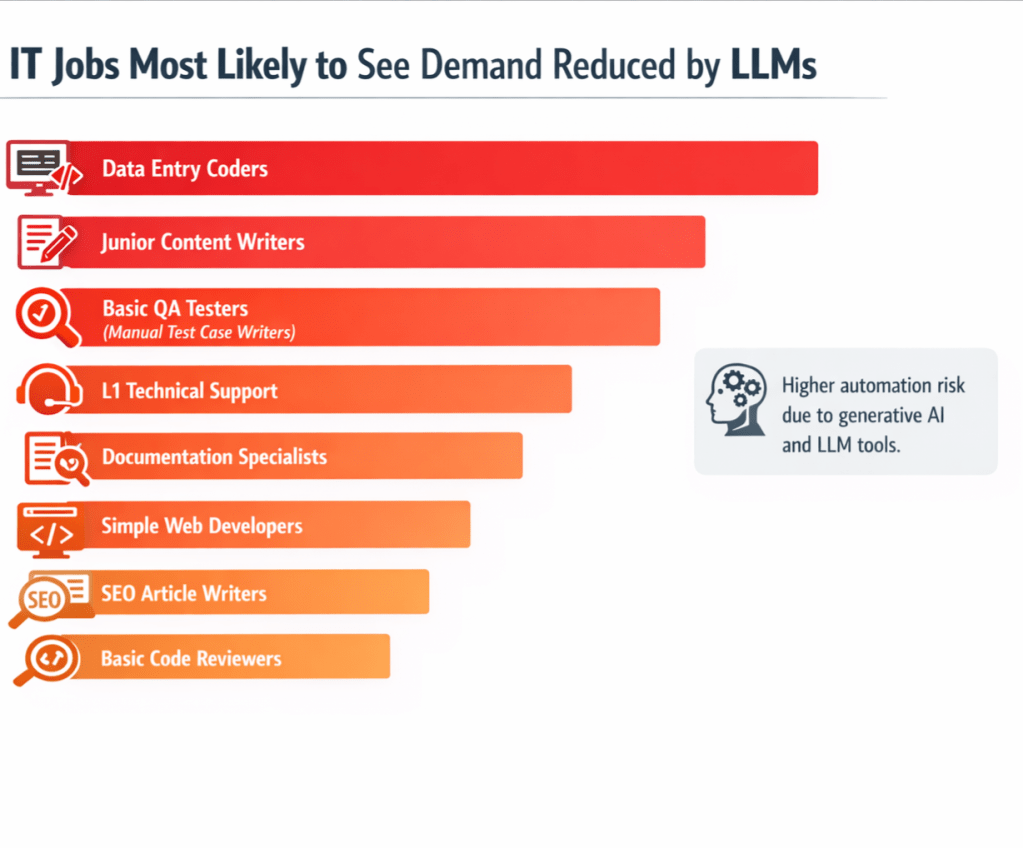
THe rapid advancement of large language models (LLMs) and generative artificial intelligence is reshaping the structure of work within the information technology sector. As organizations increasingly integrate AI tools into their software development and operational processes, certain roles that rely heavily on repetitive, rule‑based, or standardized tasks are likely to experience a significant decline in demand. This shift does not necessarily imply the complete disappearance of these jobs, but rather a transformation in the nature of work as automation absorbs routine activities.
One of the most vulnerable roles is that of data entry coders. Historically, many IT systems required human workers to manually input structured data, categorize information, or convert documents into database-compatible formats. With the emergence of AI-powered tools that combine optical character recognition, natural language processing, and automated data extraction, much of this work can now be completed automatically. Modern AI systems can scan documents, interpret structured and unstructured text, and populate databases with minimal human supervision. As a result, organizations can process large volumes of data more efficiently while reducing reliance on manual data entry tasks.
Another category likely to face reduced demand is junior content writing, particularly in technical documentation and basic digital content production. Generative AI tools are capable of producing blog articles, summaries, product descriptions, and instructional content at remarkable speed. Companies that once relied on teams of entry-level writers to produce large volumes of digital content can now use AI systems to generate first drafts almost instantly. Human writers will still be needed for editorial oversight, accuracy verification, and strategic storytelling, but the volume of entry-level writing work may decline as AI-assisted content creation becomes standard practice.The role of basic quality assurance testers, especially those focused on manual test case development, is also undergoing transformation.
In modern DevOps environments, automated testing has already reduced the need for manual testing processes. AI-powered systems can analyze software requirements, generate test cases, simulate user interactions, and detect potential bugs before code is deployed. Large language models further enhance this capability by reading program documentation and automatically generating comprehensive testing scenarios. As testing processes become increasingly automated, organizations may require fewer professionals dedicated solely to manual QA activities.
Similarly, Level 1 technical support roles are becoming increasingly automated. L1 support teams typically handle routine queries such as password resets, installation guidance, or basic troubleshooting. AI-powered chatbots and intelligent helpdesk platforms can now answer many of these questions instantly. By accessing extensive knowledge bases and interpreting user questions through natural language processing, these systems can guide users through solutions without human intervention. While more complex technical problems will still require skilled engineers, the demand for large teams of entry-level support staff may gradually decline.The influence of AI also extends to documentation specialists and SEO-focused article writers.
Large language models can quickly generate technical documentation, summarize system processes, and produce search-optimized content for digital platforms. Although human oversight remains essential to ensure accuracy and maintain brand voice, AI significantly reduces the time required to create initial drafts. This efficiency means organizations may rely on smaller teams focused more on editing, verification, and content strategy rather than large groups producing documentation from scratch.Finally, simple web development tasks and basic code review functions are increasingly being assisted by AI tools. Modern AI coding assistants can generate website templates, suggest improvements, and automatically identify syntax errors or security vulnerabilities. Tasks that once required junior developers—such as creating simple web pages or performing routine code checks—can now be performed partially or entirely by AI-enabled development environments.
Despite these changes, it is important to recognize that AI is more likely to reshape jobs rather than eliminate them completely. As automation takes over repetitive tasks, human professionals will increasingly focus on higher-level responsibilities such as system architecture, complex debugging, product design, and strategic decision-making. In this evolving landscape, individuals who learn to work alongside AI tools and develop advanced technical and analytical skills will remain highly valuable. The future of the IT workforce will therefore depend not only on technological progress but also on how effectively professionals adapt to an AI-augmented work environment.

 Tech Talk
You must be logged in to post a comment.